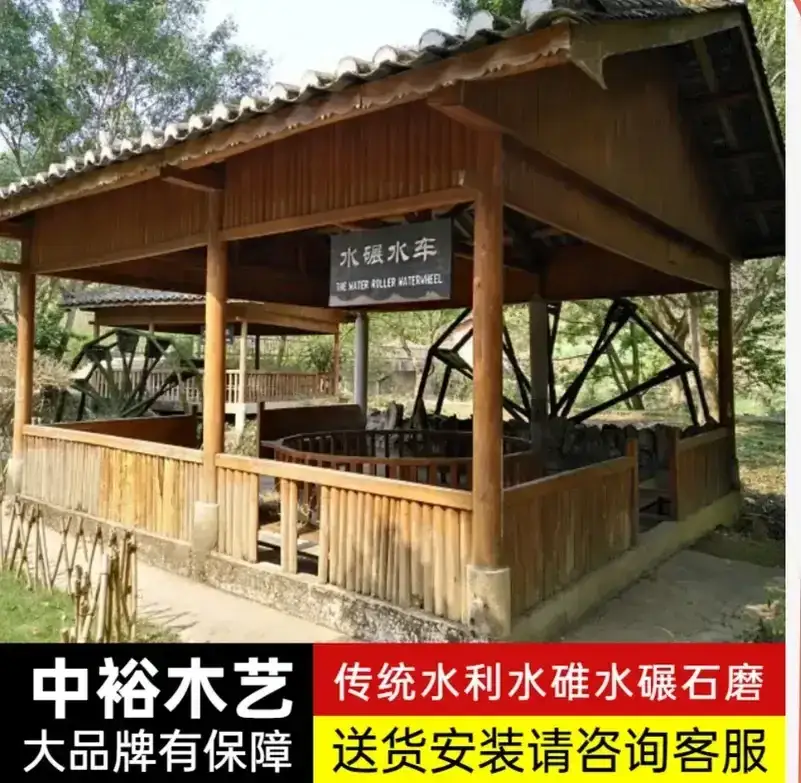
A 1:1 Museum Waterwheel: The Axle Decides Whether It Can Tour
A full-size dragon-bone lift wheel with a 4.2 m diameter reads as the simple part of a museum build. What ends projects is the axle: at 1:1 scale it carries the wheel, the water in the trough and the torque of whoever turns it, and every crate it travels in has to protect that shaft rather than the paddles visitors photograph. Curators usually approve the silhouette first and the bearing last, and the bearing is the line item that decides whether the object can leave the building at all.
This article is written from the workshop side of that problem. It covers what “1:1” fixes, why the axle and bearing choice drives the budget, how a wheel is crated for a touring schedule, and what a registrar should demand in the maintenance sheet before accepting the object.
What 1:1 actually fixes, and what it leaves open
Chinese texts describe the machine before they describe the exhibition. Tiangong Kaiwu (1637), in the section on grain and water lifting, describes the paddle chain running in a trough, and Nongzheng Quanshu (1639), in the irrigation plates of juan 17, draws the same device as a series of boards carried between two ends. The mechanism is a chain of paddles, not a bucket wheel, and that single fact constrains a replica: the trough length, the paddle pitch and the wheel diameter are locked to each other, so a curator cannot shrink the wheel by 20 percent and keep the same trough.
Those three dimensions are the ones visitors and staff actually measure:
Diameter and paddle pitch
At 4.2 m the wheel has a circumference of roughly 13.2 m. With a paddle every 0.33 m, that is about 40 paddles, and the trough has to match the arc the paddles sweep. Change the diameter and the paddle count changes; change the count and the trough is wrong.
Width, axle height and guard line
A 0.9 m working width is enough for a demonstration flow without making the frame too wide to pass a standard 1.2 m door with the wheel removed. Axle height at 2.6 m keeps the low paddles visible at child eye level while leaving clearance under the frame for a drip tray.
The frame footprint
Allow 1.6 m of floor beyond the wheel on each side. That is not decorative margin: it is the distance a visitor steps back when the wheel starts, and the space a registrar needs to walk a condition report.
Three replica tiers, and where the money goes
Museum buyers tend to ask for “a replica” and receive three very different objects. The table below is the way we quote, and the difference between tiers is almost entirely axle, bearing and motion control, not timber volume.
| Tier | Motion | Axle and bearing | Guard and controls | Packed volume | Typical use |
|---|---|---|---|---|---|
| Static display | None; wheel locked | Fixed shaft in hardwood blocks, no bearing | Low barrier, no interlocks | About 6.5 m3 in 9 crates | Permanent gallery, no touching |
| Hand-crank demonstration | One crank, 8-12 rpm | Bronze bushing, greased, replaceable | Guard ring at 1.1 m, crank clutch | About 8 m3 in 12 crates | Led demonstration, school groups |
| Motorised interpretive | Geared motor, variable speed | Tapered roller bearing in a sealed housing | Interlocked gate, emergency stop, 1.5 s braking | About 10 m3 in 14 crates | Touring blockbuster, unattended hours |
The static tier is cheapest to build and most expensive to interpret: without motion, the label has to carry the whole explanation. The motorised tier costs more in control hardware than in wood, and it is the only one that survives a touring schedule without a demonstrator standing next to it.
The axle: where a replica fails quietly
Three numbers decide the axle, and all three should appear in the specification before the purchase order:
1. Load at the shaft
The wheel plus the water in the trough is the static load; the crank force is the transient one. A 4.2 m wheel built in our shop lands in the range of 600 to 900 kg with hardware, before water. A bushing rated for the static load alone will ovalise within a season of demonstrations.
2. Speed and stopping distance
Demonstration speed should stay between 8 and 12 rpm. Faster looks wrong, and the paddle tips start throwing water. On the motorised tier, the stop time matters more than the top speed: with a 1.5 s ramp-down the wheel does not coast into the guard, which is the failure a risk assessment will ask about.
3. Serviceability without disassembly
Ask whether the bearing can be replaced with the wheel in place. On our frames it can: the bearing housing is bolted to the axle saddle from the outside, so a registrar does not have to de-rig the wheel to change a bushing.
Crating for a touring schedule
A touring waterwheel is a crate problem before it is an object. The packing list we ship for the hand-crank tier:
The crate list
Six wheel segments, three trough sections, four frame posts, one axle and two bearing housings, one crank assembly, one hardware box, one touch-up box. Fourteen crates for a motorised wheel, twelve for a hand-crank. Each segment sits in a plywood cradle with foam at the rim, and the axle travels in its own box with the bearing housings bolted to a dummy plate so the seats cannot be knocked out of alignment.
Volume and container
The hand-crank tier packs to about 8 m3, which leaves room in a 20-foot container for a second small object. The motorised tier at 10 m3 is a container on its own once you add the control cabinet.
Re-assembly limits
Our joints are through-tenons with wedged pegs, so a venue change is a re-pegging job, not a glue job. We specify re-tightening after every third assembly, and a full hardware inspection after every fifth. That number belongs in the loan agreement, not in a manual nobody reads.
The maintenance sheet a registrar should demand
A replica waterwheel is a machine and should be logged like one. The sheet we send with every wheel covers four intervals:
Weekly, during demonstrations
Wipe the trough dry after the last run, check the crank clutch for play, and look at the paddle roots for water staining, which is the first sign a peg has worked loose.
Monthly
Grease the bushing, check the guard ring fixings, and run the wheel through a full revolution by hand to feel for a tight spot.
After every venue
Photograph each joint before de-rigging. A condition report with 24 photographs is cheaper than a dispute about who cracked a paddle.
Annually
Re-coat the exterior surfaces with tung oil, inspect the axle for run-out, and replace any peg that has compressed more than a millimetre.
Frequently asked questions
Can a 1:1 wheel be built to fit an existing trough?
Yes, if the trough is measured first. Diameter and paddle pitch are derived from the trough length, so the sequence is survey, then design, then cut.
Is treated timber acceptable for a museum object?
For a hands-on interpretive replica, yes, with the treatment disclosed in the condition report. For a permanent gallery piece, we use untreated hardwood and control humidity instead.
How long does installation take?
Two people, two days for the hand-crank tier, including the drip tray and guard. The motorised tier adds a day for controls and commissioning.
Does the wheel need a water supply?
No. A recirculating tray with a small pump is enough for the visual effect, and it keeps the load and the humidity predictable.
Where this fits in a gallery plan
Museum projects rarely buy one object. The same workshop supplies chariot replicas and siege engines for the same galleries, and the joint language is deliberately shared so a registrar learns one maintenance vocabulary. If your exhibition plan includes a water-lifting station next to a transport or warfare section, read our notes on siege engines and chariots in museum display before the layout is fixed.
For sizing, crate volume and a costed comparison of the three tiers, the specification page on custom waterwheel pricing and factory options carries the same numbers we quote here.
Talk to the workshop
Send the trough length, the door width and the display floor plan, and we will return a tier comparison with packed volume and a maintenance sheet in the same document. Scene consultation for museum and touring projects: waterwheel specification and pricing, or call +86 138 8336 6528.