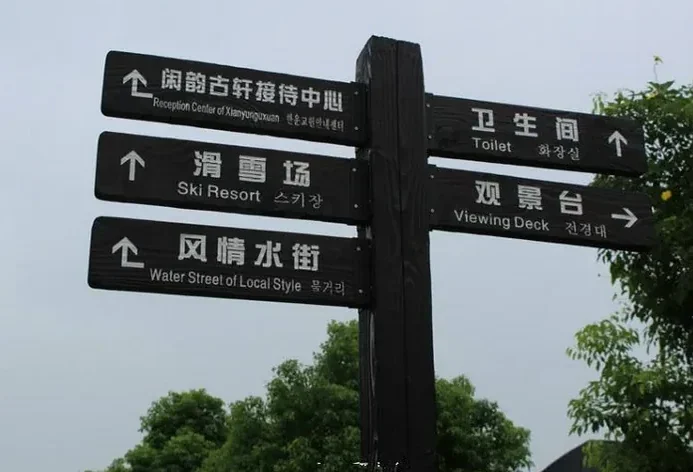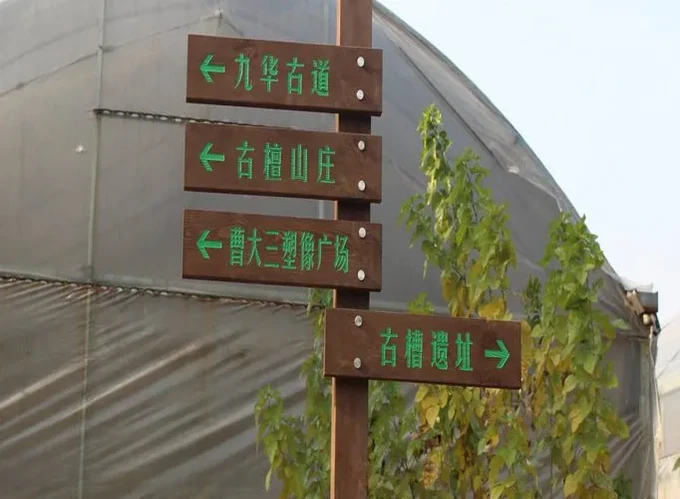
A board placed to face the path serves the path. A board placed to face the plant serves the collection. On a 40-hectare botanical garden the difference is roughly 90 boards that visitors actually stop at, and the same 90 that they walk past because the text answers a question nobody asked at that spot.
The post detail matters as much as the words. In a collection with irrigation, mulch beds and a water table that moves twice a year, a timber post fails from the bottom up, and the board above it stays perfectly legible while the whole sign starts to lean.
Site the board where the question happens
Visitors ask three kinds of question in a plant collection: what is this, why is it here, and how do I get to the glasshouse. Each belongs at a different distance from the plant. The identity answer belongs within 3 m of the specimen, at reading height, with the label angled toward the approach, not the path centre. The interpretation answer – why this collection exists, what the species is used for – belongs at a stopping point where a person can stand out of the flow, which usually means 1.5-2 m off the path edge and slightly turned.
The wayfinding answer belongs at a decision point and nowhere else. Boards that repeat the map every 20 m teach visitors to ignore maps. One board at each junction, with the current position marked and the next two junctions named, works better than ten boards that all show the same overview.
What the 1631 garden manual says, and what it leaves open
The Yuan Ye (Craft of Gardens, Ji Cheng, 1631) is the source most cited for Chinese garden layout, and two of its principles translate directly into signage siting. “Xiang di” (reading the site) argues that the ground decides the building, not the drawing; “jie jing” (borrowed scenery) argues that a structure should frame what already exists rather than compete with it. Applied to a collection, that means the board should sit where it borrows the specimen as its illustration, and should never be the tallest object in the frame.
What the manual does not give is a height. For that the useful text is the Mengxi Bitan (Dream Pool Essays, Shen Kuo, 1086), which records Yu Hao’s Mujing (Timber Manual) and its division of a building into three parts: the upper section above the beams, the middle section from the base to the beams, and the lower section, the platform. The proportion is architectural, not graphic, but it explains why a 1.2 m board on a 2.4 m post reads as balanced in a garden while the same board on a 1.6 m post reads as a road sign.
Height, angle and the 30-degree test
Three numbers settle most of it. Board centre at 1.15-1.25 m above finished ground for standing adults; top edge no higher than 1.6 m if children are expected to read it; and a board plane turned 15-30 degrees from the path direction so a visitor walking toward it sees the face, not the edge.
The 30-degree test is simple: stand where a visitor would first notice the board. If you see less than half the face, the board is turned wrong, and no amount of type size fixes it. Boards that face straight across the path are readable only when the visitor is already beside them, which is why so many collection labels are read from behind.
Text volume per board
One idea per board: 40-70 words for a specimen label, 120-180 for an interpretation panel, plus the botanical name and family. Long panels are read in the first ten seconds or not at all, and on a garden route the second reading happens at the bench, not at the post. Where more has to be said, a small QR code at the bottom right links to the living-collection database without competing with the name.
Post detail in wet ground
Most failed signs in a collection are not damaged boards, they are posts that rotted at the 200-400 mm band where soil stays damp and air does not move. Three foundation options cover the range, and the choice is driven by ground conditions rather than by budget alone.
| Foundation | Best ground | Install time per post | Rot risk at the base | Notes |
|---|---|---|---|---|
| Direct burial in gravel collar | Well-drained beds, low water table | 25-35 min | High unless the post is heartwood and the collar drains | Cheapest; replaceable; not for irrigated beds |
| Sleeve in a concrete ring | Irrigated beds, clay | 60-90 min | Low: post sits above the wet band on a sleeve | Our default for collections with automatic irrigation |
| Surface plate on a paved edge | Plazas, terrace edges, root protection zones | 20-30 min | Very low: no ground contact | Best where digging is forbidden near tree roots |
The 600 mm rule follows from this: keep the bottom rail and the board’s lower edge at least 600 mm above finished ground, and keep the post’s ground contact zone in a material that can be replaced. A post that is bolted to a sleeved base can be swapped in fifteen minutes without touching the board. A post buried directly cannot, and in a collection with 200 labels that difference is a maintenance contract, not a detail.
Material and finish that survive a wet season
We specify a durable hardwood – teak where the budget allows, otherwise a preservative-treated species with the treatment penetrating rather than surface-coated – and we leave the post’s lower 300 mm untreated where it sits in a sleeve, because a coating that traps moisture behind it accelerates the failure it was meant to prevent. Boards are planed, not sanded smooth: a planed face holds ink and repels water better than a polished one, and it does not show every fingermark.
Lettering is engraved and filled, not printed on film. Films lift at the edges within two seasons in a humid collection, and once water sits under the film the timber goes grey. Engraved lettering can be re-filled in place with a brush, which a volunteer can do on a maintenance morning.
Maintenance across the year
Twice a year, at the start and end of the wet season: probe the base band for softness with a knife point, re-fill weathered lettering, confirm the board is level. Once a year: inspect the sleeve or plate fixings and clear the drainage path under the collar. After any irrigation main work: re-check the two nearest posts, because trenching changes how water moves and last year’s dry post may now be standing in a sump.
Where a collection is replacing labels in phases, replace the post and the board together on irrigated beds. A sound board on a failing post is the most common false economy in garden signage: the post is 20 percent of the cost and 80 percent of the failure.
Frequently asked questions
How far apart should specimen labels be on a mixed border?
One label per specimen clump, not per plant, and no closer than 1 m unless the clump is the interpretive point. Crowded labels teach visitors to stop reading.
Can a single board carry both the map and the plant story?
It can, but it should not. Maps belong at junctions, plant stories belong beside plants, and combining them produces a board that is legible at neither distance.
What is a realistic budget per board for a public collection?
Timber board with engraved lettering and a sleeved post typically lands between USD 180 and 420 depending on size and species, before installation. The sleeve adds cost and removes ten years of replacement labour.
Do we need root protection approval for posts?
Usually yes within the drip line of a mature tree. The surface-plate foundation avoids the question entirely and is what we recommend within protected root zones.
Next step
Send a route plan with the junctions marked and the species list you intend to label. We will return a board schedule with heights, angles and foundations matched to your irrigation layout. Start with the specification in teak scenic wayfinding sign and guide boards, and read the sizing and maintenance guide for park wayfinding if your collection shares routes with a public park.
Zhongyu Wood Craft, Chongqing. Phone and WeChat: +86 138 8336 6528. Boards are shipped in numbered crates with a fixing schedule, and we quote in USD.