A school programme that runs six classes through a farm-skills station before lunch will put 180 students through one water lift. The lift that looks right in a photograph usually cannot do that: it needs two adults to prime, it cannot be stopped by a child, and the queue backs into the next station within twenty minutes.
We build agricultural learning stations in the same workshop as scenic waterwheels, and the difference is not size. It is who is allowed to touch the machine, how often, and how quickly the next group has to start. That single question sets the drive type, the guard detail, the water volume and the maintenance interval for the rest of the year.
Why the timetable decides the machine
Take a standard primary-school visit: 30 students, a 45-minute rotation, six rotations between 9:00 and 12:30. If a station serves three operators at a time and a full fill-drain cycle takes four minutes, it delivers roughly 20 children per hour per station. Three stations in parallel cover the morning; one station does not, no matter how large the wheel is.
This is the arithmetic we ask for first, before a drawing exists: youngest operator age, rotation length, adults available, and the number of classes in a morning. A station sized from a photograph and then asked to run a timetable is the most common failure we see on site.
What the historical sources specify, and what they leave open
The Chinese agricultural manuals describe water lifting in operational terms rather than as decoration. In Tiangong Kaiwu (The Exploitation of the Works of Nature), the sections on grain and on water engineering present the lift as part of a field system: a frame, a trough and a chain of paddles sized as one set to move a known volume of water to a known height.
In Nongzheng Quanshu (Complete Treatise on Agriculture), the irrigation plates of juan 17 show the fanche — the dragon-bone lift — as a family of machines with different drives and different working positions: treadle, hand-crank, and animal or water drive. What the plates leave open is exactly what a school needs: the supervision envelope. A treadle lift drawn for two adults working a field is not automatically safe for thirty children in rotation, and no woodwork drawing settles that question.
Three station types and what each costs in supervision
The three types below cover most study bases. Cycle time is the realistic time for one group to fill, observe and drain, including the handover.
| Station type | Typical footprint | Operators | Cycle time | Supervision load | Water per cycle |
|---|---|---|---|---|---|
| Treadle lift (foot-driven, low basin) | 2.4 x 1.6 m | 2 children + 1 adult | 4–5 min | High: balance and stepping rhythm | 40–60 litres |
| Hand-crank lift (chain of paddles) | 2.0 x 1.2 m | 1–2 children + 1 adult | 3–4 min | Medium: crank speed and grip | 25–40 litres |
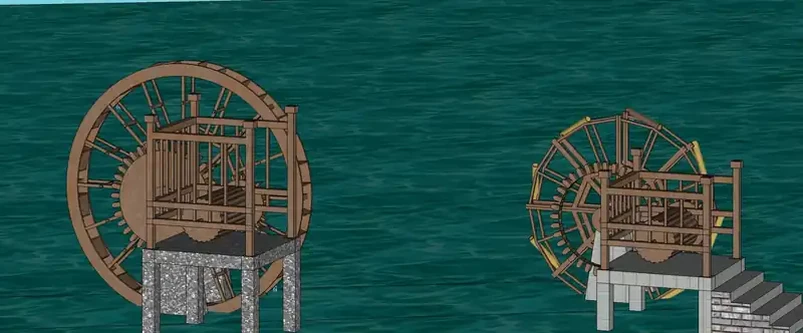
| Water-wheel demonstration (guarded, non-contact) | 3.0 x 1.2 m | 1 adult, group watches | 8–10 min talk | Low: viewing distance only | closed loop |
The safety envelope, in numbers
Four decisions do most of the work, and all four belong in the drawing rather than in a briefing sheet. First, the wheel must come to rest within one revolution after the operator lets go — a flywheel that coasts for eight turns is a queue hazard, not a teaching aid. Second, every accessible nip point sits behind a fixed guard at least 60 mm clear of the moving member, so a sleeve cannot be drawn in. Third, the basin is a low retaining pool rather than a raised trough: a raised trough collects children’s weight on its rim edge and fails at the joint within a season. Fourth, the station has one defined stop position, marked on the frame, so the adult supervisor can end a cycle without negotiating with the group.
Course flow: how the station fits a teaching sequence
A station that works alone is a fairground ride. A station that works inside a sequence is a lesson. We usually propose three positions on one deck: lift, screen, and measure. The group lifts water at the wheel, pours it through a sluice into a calibrated tank, and reads the volume against a printed card. Twelve minutes per position, forty minutes with handover, which matches a 45-minute rotation.
The worksheet matters more than most buyers expect. If the teacher has to invent the questions on the bus, the station becomes a photo stop. We supply a one-page card per position with three prompts: what the machine moved, how much, and what changed when the drive changed.
Installation on a school or park site
Three site conditions decide the build: a level deck of at least 30 m2 with drainage to a soakaway, a water supply that can refill the basin in under ten minutes, and a route wide enough to carry the frame in without dismantling the guard. Timber arrives in crate-sized subassemblies with pegged mortise and tenon joints; a two-person crew typically assembles a treadle station in three to four hours, then runs it dry before the first class.
Footings matter on made ground. We specify a spreading base under each post rather than a single embedded leg, because a station on fill settles unevenly and the trough then sits out of level — which reads to a child as “broken”.
Maintenance between terms
A study base has two maintenance windows: the end of term and the week before opening. Between them, the checks that actually prevent failure are few. Grease the axle bushes, clear the trough of grit, re-tighten the guard bolts, and inspect the basin rim joint for standing water. Standing water at a rim joint causes most of the premature decay we repair on outdoor stations, and it usually starts within the first wet season rather than after years of use.
| Check | Interval | Failure it prevents |
|---|---|---|
| Axle bush clearance and lubrication | Every 40 operating hours | Seizing, then a snapped crank arm |
| Paddle chain tension | Monthly in season | Paddles scraping the trough floor |
| Guard bolt torque | Start of each term | Guard loosening under hand pressure |
| Basin rim joint and drainage | Start and end of term | Water ingress and joint decay |
| Trough grit removal | Weekly in use | Blocked flow, misleading volume readings |
Frequently asked questions
Can children operate a treadle lift at all?
Yes, with a low basin, a guard on every nip point, a stop inside one revolution, and one adult per two children. What is not acceptable is a field-scale treadle frame with an unguarded pit wheel.
How much water does a station need?
A treadle cycle uses 40 to 60 litres; a hand-crank cycle 25 to 40. A 300-litre basin with a float refill covers a full morning without a supervisor stopping to refill.
Do you provide the worksheet and the safety briefing?
We provide a printed card per position and a one-page supervisor sheet listing the stop position, the guard checks and the cycle order. The teaching content stays with the school.
What decides the price more than size?
The number of stations in parallel, the guard detail, and whether the basin is a poured retaining pool or a fabricated tank. A single large wheel is often cheaper than three small stations that cannot share a deck.
Next step
Send the youngest operator age, the rotation length, and the number of classes per morning. We will return a station count and a deck layout, not a catalogue page.
For sizing and budget ranges, see our waterwheel cost and sizing guide. For the wider study-base programme, the earlier piece on heritage workshop demonstrators for schools covers the same supervision logic.
Zhongyu Wood Craft, Chongqing, working since 1978. Tel and WeChat: +86 138 8336 6528.
Call/WhatsApp: +86 13883366528
Zhongyu Woodcraft – 48 Years Traditional Chinese Woodcraft Factory, Nationwide Installation