A wedge press is one of the few machines that teaches physics, food history and craft discipline at the same time, and it is also one of the few that can hurt a student if it is scaled wrong. Schools and heritage workshops that want a working press on the floor need a specification, not a replica.
The Tiangong Kaiwu (The Exploitation of the Works of Nature, Song Yingxing, 1637) treats oil pressing in its chapter on oils and fats, Gaoye, where the sequence runs from roasting and grinding to steaming, wrapping in cloth, and pressing with wedges driven by a heavy beam. That sequence is the lesson. The machine only has to make it visible and safe.
What the press actually teaches
Three things, and none of them are “heritage” in the decorative sense.
Mechanical advantage. A wedge converts a small horizontal force into a large vertical one. Students can measure it: input force on the beam, output force on the cake, and the ratio between them. A press with a known wedge angle turns that into a calculation they can check against a spring scale.
Process control. Oil yield depends on roast temperature, grind size, steam time, and pressing rate. Change one variable, hold the others, and the yield moves. That is a controlled experiment with a physical result, which is rare in a classroom.
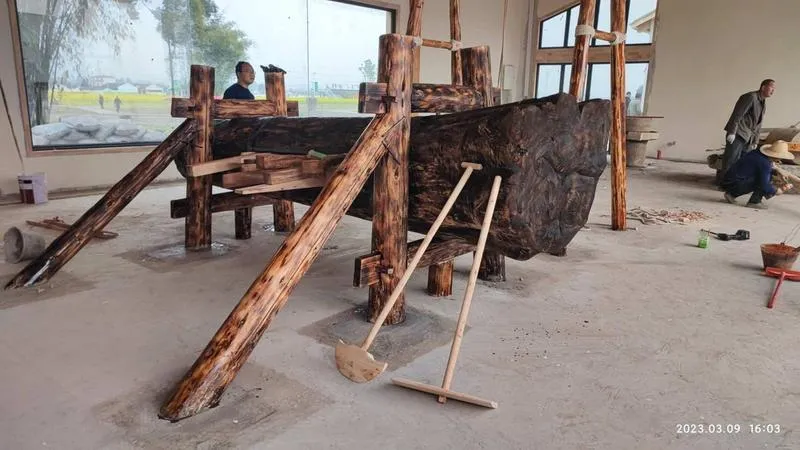
Material behaviour. The press frame carries a load that reverses direction every stroke. Students can see why the beam is a single piece of dense hardwood, why the wedges are iron rather than timber, and why the frame is braced rather than bolted square.
Scaling for a school floor
Full-size presses are built to be operated by two adults with a swinging beam, and they are not suitable for unsupervised student use. A demonstrator is scaled down in three dimensions, not one: shorter beam, smaller wedges, and a shorter stroke, so the force at the handle stays within what a supervised pair of students can apply.
| Option | Beam length | Cake diameter | Students per cycle | Output per session | Best for |
|---|---|---|---|---|---|
| Table-top screw press | No beam, hand screw | 120 mm | 1 | Small, demonstration only | Classroom bench, ages 8-11 |
| Half-scale wedge press | 1.6 m | 200 mm | 2 | 300-500 g per pressing | School workshop, ages 12+ |
| Two-thirds scale wedge press | 2.4 m | 260 mm | 2-3 | 1-2 kg per pressing | Heritage centre with supervision |
| Full-size production press | 4.0 m and above | 350 mm and above | 2 adults | Production volumes | Working oil mill, not a classroom |
The half-scale press is the practical answer for most schools: heavy enough that the mechanics are real, light enough that two students can work it under supervision, and small enough to fit through a standard door.
Safety detailing that has to be designed in
The beam. A 2.4 metre hardwood beam weighs enough to injure a hand if it drops. It needs a counterweight or a spring return, a stop block at the end of travel, and a clear floor zone marked on the ground.
Pinch points. Wedges and the wedge channel are the highest-risk area. Guard the channel with a fixed grille that still allows observation, and require a wooden drift and a mallet rather than fingers for wedge setting.
Temperature. Roasting and steaming introduce hot surfaces into a school setting. Keep the roaster as a separate, supervised station, or use a pre-roasted, pre-ground input for younger groups so the press lesson stays mechanical.
Mass and lifting. The frame should break down into parts no single person has to lift above waist height, and the assembly should be possible with two people and a documented sequence. If it needs three, the design is wrong for a school.
Materials and detailing
The frame wants dense hardwood — oak or a dense Chinese hardwood such as camphor or pearwood offcuts — with wedges in mild steel, not timber, because timber wedges compress and lose force. All surfaces that touch the oil cake should be unfinished hardwood or food-grade stainless, never varnished.
The screw press variant is simpler to guard and easier to operate, but it teaches less: a screw gives a smooth, predictable ratio and hides the wedge mechanics that made the traditional press a two-person job. Many education programmes run both: the screw press for the youngest group, the wedge press for the mechanics lesson.
A three-lesson arc that works
Lesson one, disassembly.Take the press apart on the bench. Identify frame, beam, wedges, channel, cake ring, and cloth. Students draw the force path before touching the beam. Lesson two, controlled pressing. Press three cakes with different roast times, record yield by weight, and plot the result. The measurement is the point. Lesson three, maintenance. Inspect the wedge faces, check the frame for crushing at the joint shoulders, re-oil the bearing surfaces, and write the inspection into the log. This is the lesson most programmes skip and most equipment needs.
Installation and the annual cycle
Set the press on a level, load-bearing floor with a 1.5 metre clear working zone on the beam side. Anchor the frame at the base only, so the frame can move slightly under load without tearing its own joints. Keep a maintenance kit with the machine: spare wedges, a drift, a mallet, a grease stick, and a printed assembly drawing.
Once a year, take the frame apart, inspect the tenon shoulders for crushing, replace any wedge that has mushroomed at the head, and re-check every fastener. A press that is inspected annually will outlive the programme that bought it.
Frequently asked questions
Can students actually produce usable oil? Yes, in small quantities, and that is the most persuasive part of the lesson. Food use depends on local rules; many programmes press for demonstration and discard the output.
How long does a half-scale press take to build? Six to eight weeks including drawings and the safety guard, with the guard designed before the frame is cut.
Does it need a dedicated power supply? No. The half-scale wedge press is entirely manual, which is one reason it suits sites without services.
Can it be used outdoors? Only with a cover and a drainage detail; the wedges and the iron channel are the parts that suffer first.
Do you supply the curriculum? A three-lesson outline, a parts list and an assembly drawing come with the machine; the teaching sequence is written to be adapted, not followed word for word.
For the full-size version of the same machine, including the roasting and steaming stations, see our traditional oil press range. For the mechanics of another traditional machine that schools often pair with it, read this guide to how ancient waterwheels work. Send the age range of the group, the floor area, and whether the press must produce food-grade output, and you will get a scaled proposal with a guard drawing.
Zhongyu Wood Craft, Chongqing, China. Heritage timber work since 1978. Telephone and WhatsApp: +86 138 8336 6528.