A waterwheel is a machine before it is a photograph
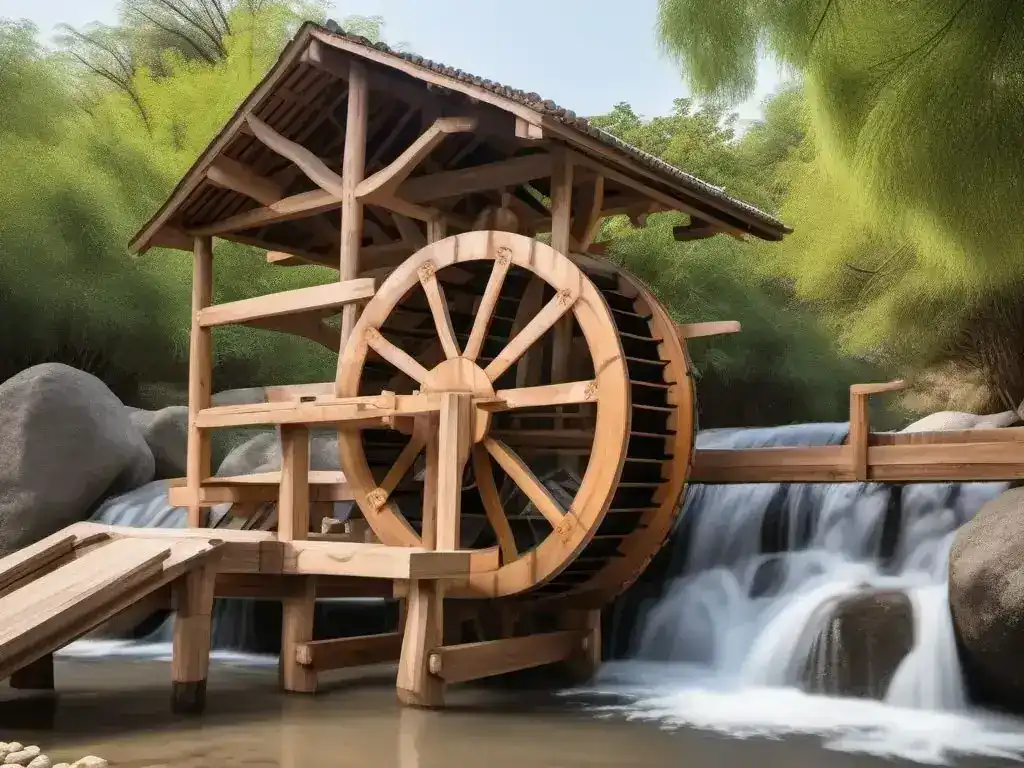
Every week someone sends us a picture of a stone-and-timber wheel turning beside a stream and asks whether we can build one like that, but bigger. The honest answer starts with a correction: the wheel in that picture is not a prop. It is a pump, a mill, or a drive train that once lifted water over a bank or turned a stone roller, and it only looks effortless because the people who built it solved a set of mechanical problems that Chinese agricultural manuals wrote down centuries ago. When a landscape scheme treats the wheel as scenery and ignores those problems, the result is a structure that squeals, stalls, or tears itself apart within two seasons.
This guide sets out what the classics actually specify, then translates those specifications into decisions a project team can use today: wheel diameter against flow, timber choice against permanent wetting, bearing design against grit, and the maintenance rhythm that keeps a heritage-grade wheel turning.
What the Chinese classics actually specify
Three texts matter more than any modern brochure: Tiangong Kaiwu (The Exploitation of the Works of Nature, Song Yingxing, 1637) for the tube wheel, Nongzheng Quanshu (Complete Treatise on Agricultural Administration, Xu Guangqi, 1639) for the dragon-bone pump and for the screw-type lifting wheel, and the carpenter’s tradition preserved in the Lu Ban Jing (The Lu Ban Manual) for rule-based proportioning of timber frames. None of them are decorative. Each records dimensions, materials and failure modes.
The tube wheel
In the first chapter of Tiangong Kaiwu, in the water-lifting section, Song Yingxing describes the riverbank wheel in operational terms. Translated closely: where a river bank allows, men build a weir to divert the current so that it passes beneath the wheel; the current drives the wheel around, the wheel lifts water into its tubes one by one, and each tube tips into a flume that carries the water into the fields. Day and night without rest, a hundred mu need not worry. He adds the detail that matters for any site today: when water is not wanted, a wooden brake is set against the wheel to stop it turning. He then notes the alternative for still water — ox-driven gearing, or several people treading the wheel — and gives the size range: the body of the wheel is two zhang long (about 6.4 m in Ming measure) at the upper end, half that at the lower.
Read as an engineering note, that passage contains four design decisions: a diversion works rather than a dam; a wheel whose rim speed is set by the current, not by a motor; a braking method that is wooden and external, so nothing inside the hub has to be reached; and a size range tied to the available head and flow. A modern landscape wheel that ignores the weir and relies on a submersible pump to spray water over the top is imitating the picture while discarding the machine.
The dragon-bone pump
Xu Guangqi’s Nongzheng Quanshu, in the irrigation plates of volume 17, opens with a definition and a history: the fanche, which people today call the dragon-bone cart (longguche). He traces it to Ma Jun, who built one to water a garden inside the city, and to Bi Lan, who set one to lift water for the roads north and south of the capital in the Eastern Han. Then he gives the build: apart from the pressing rails and the row of stake posts, the body is a trough made of planks, up to two zhang long, of variable width from four to seven cun (roughly 13 to 22 cm), about one chi high, with a track of boards laid along the trough and an endless chain of pallets running between them.
The point for a buyer is that the dragon-bone pump is a chain machine: its output depends on pallet spacing, trough fit and the alignment of the end wheels, not on the beauty of the frame. We have rebuilt these for museum courtyards and for farm-stay sites, and the failures are almost always the same: pallets that rub because the trough was made five millimetres too narrow, or an idler wheel mounted three millimetres off centre so the chain climbs the side wall. The Ming text is precise about the trough for exactly this reason.
The screw lifting wheel
Volume 19 of the same book carries the Taixi Shuifa, the hydraulic treatise brought by Jesuit engineers and edited into Chinese by Xu Guangqi. It describes the dragon-tail wheel (longweiche) as six parts: the shaft, the side walls that confine the water, the outer casing that holds the whole together, the pivot that lets it turn freely, the wheel that receives the drive, and the frame that fixes the height. That six-part decomposition is a useful checklist in its own right. When we specify a lifting wheel today, those six functions still have to be assigned to something, and any scheme that leaves one of them to “the installer will figure it out” is a scheme that will leak or seize.
From field pump to heritage landscape: what actually changes
A wheel standing in a cultural park or a hotel garden has a different duty cycle from a wheel irrigating rice. It runs intermittently, it is photographed from every angle, it must be safe for visitors who will climb things they should not climb, and it has to survive being dry for weeks and then submerged. The mechanics stay; the specifications move.
| Function | Agricultural original | Heritage landscape adaptation |
|---|---|---|
| Drive | River current, ox gearing, or treaders | Current where a legal diversion exists; otherwise a low-speed electric drive with a variable-frequency controller sized for the wheel’s torque, not its speed |
| Lifting elements | Bamboo or wooden tubes, pallet chain | Tubes retained for authenticity; pallets upgraded to kiln-dried hardwood with replaceable wear strips |
| Bearings | Wooden pivot in a stone or timber socket | Bronze bush or sealed bearing inside a wooden-looking hub, with a grease point reachable without scaffolding |
| Structure | Frame tied to the bank | Engineered frame with a load path to a foundation designed for saturated soil and, where required, flood loading |
| Stop control | Wooden brake on the rim | Rim brake retained as the visible mechanism, backed by an electrical interlock for visitor safety |
Materials and joinery in permanent wetting
The classic timber for wet work in Chinese practice was not a single species but a rule: heartwood only, straight grain, no sapwood in the water line, and joints that shed water rather than hold it. Qimin Yaoshu (Essential Techniques for the Peasantry, sixth century) is specific about felling season and timber condition, and the carpenter’s tradition behind the Lu Ban Jing codified the same instinct into proportions: a member’s thickness is derived from its span and its position, so that a wet post is never asked to carry a load its section cannot take.
In practice we specify larch or heat-treated pine for immersed members, oak or locust for wear surfaces, and we keep mortise-and-tenon joints above the water line wherever the design allows. A tenon that stays submerged will swell, and a swollen tenon splits its housing. The traditional answer is not a better tenon; it is to keep the joint dry and let the wet part be a plain, replaceable member. That is also the modern answer, and it is why our wheels are built with a sacrificial wet section that can be swapped in a day without dismantling the frame.
Sizing a wheel for a site
The numbers below are the working ranges we use for landscape wheels between two and eight metres in diameter. They are conservative; a site with a measured flow and head should always be calculated rather than estimated.
| Wheel diameter | Typical tube count | Flow to turn unassisted | Lift per revolution | Notes |
|---|---|---|---|---|
| 2.0 to 3.0 m | 12 to 18 | 0.05 to 0.12 m³/s | 0.3 to 0.6 m³ | Courtyard scale; often motor-assisted |
| 3.0 to 5.0 m | 18 to 30 | 0.12 to 0.30 m³/s | 0.8 to 2.0 m³ | Park and farm-stay scale; rim speed 0.6 to 1.2 m/s |
| 5.0 to 8.0 m | 30 to 48 | 0.30 to 0.80 m³/s | 2.0 to 6.0 m³ | Signature installation; engineered foundation required |
Two cautions, from the texts and from our own rebuilds. First, a wheel sized to the photograph rather than the flow will be under-driven and will need a motor that costs more than the wheel. Second, tube count is not a cosmetic choice: too many tubes and the wheel becomes a drag brake; too few and the lift per revolution is not worth the structure.
Installation and the maintenance rhythm
A wheel that is commissioned and then forgotten is a wheel that fails in year three. The rhythm we hand to site teams is simple: inspect bearings and grease points monthly; check pallet wear strips and tube seals quarterly; clear debris from the flume and the approach channel after every flood; re-tighten frame ties annually before the wet season; and re-oil the dry members on a two-year cycle. The wooden brake described in Tiangong Kaiwu should be exercised monthly even if the wheel is motor-driven, because a brake that has never been used is a brake that will not work.
FAQ
Can a wheel run on a still pond without a motor? No. A tube wheel needs moving water, or animal or human power. A still pond needs either a low-head screw arrangement or a drive. Anyone who tells you otherwise is selling a fountain.
Will a large wheel be noisy? A correctly built wheel is quiet: water, and a low wooden creak. Noise means misalignment, dry bearings or pallets rubbing the trough, all three of which are commissioning faults rather than design features.
How long does a heritage-grade wheel last? With the wet section treated as a replaceable part, frames of this type routinely serve twenty to thirty years outdoors; the immersed pallets and tubes are the consumables, on a five to eight year cycle depending on water quality.
Can the same frame carry a mill instead of a pump? Yes, and this is historically the more common arrangement: the same wheel drove a stone roller or a trip hammer. If a site wants a working mill, say so at design stage, because the gearing and the duty cycle change the frame.
Do you build from the old drawings or from new engineering? Both. The proportions and the visible mechanism follow the manuals and the regional typologies; the load path, the bearings and the safety interlock are engineered and documented for the site’s authority having jurisdiction.
Where this fits into a project
If you are specifying a waterwheel for a cultural park, a museum courtyard, a farm-stay cluster or a heritage corridor, the useful conversation is not about style. It is about flow, head, duty cycle and who will maintain the machine. Send us the site plan and the flow measurement, and we will return a dimensioned proposal with the wet section, the drive and the maintenance schedule itemised, so that the wheel you open with is still turning in year ten.
See the landscape waterwheel range and specification drawings on our English waterwheel product page, or talk to the workshop directly: +86 138 8336 6528.