A nightly show fires the same catapult eight times, and the machine is not the hard part. The reset is. If three stagehands cannot re-cock the arm, re-load the bucket and clear the swing envelope in under eleven minutes, the show either loses its second act or buys a second engine it does not need.
We build these engines for three buyers: museums that never move them, parks that move them nightly, and film units that shoot once from four angles. The frame looks similar in all three; the differences sit in the joints, the counterweight and the reset.
Why the show schedule decides the structure
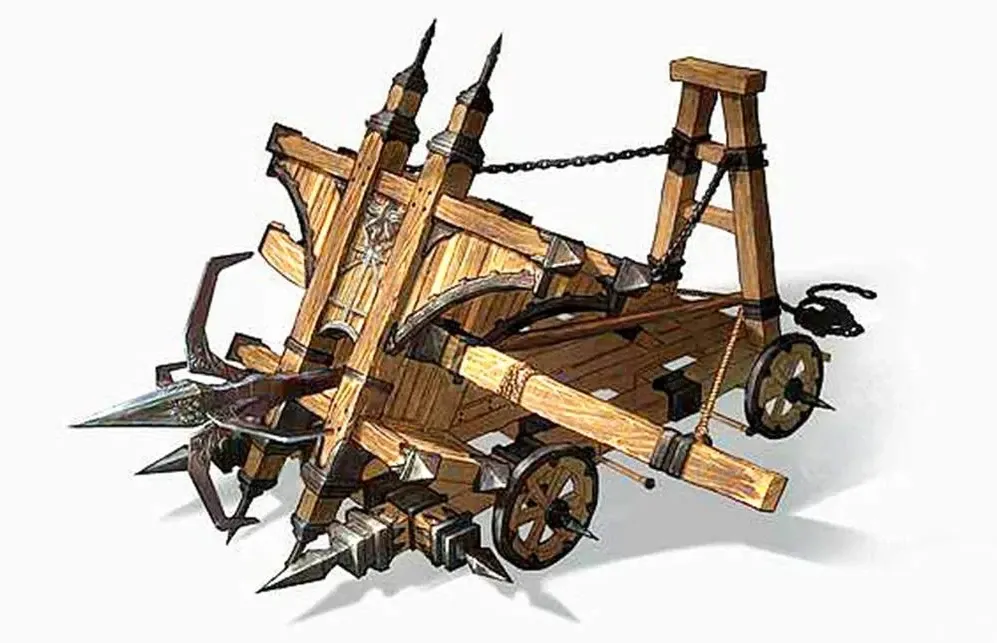
A static replica can be nailed together and painted. A working prop cannot. Every part that carries a swinging load has to be sized for the worst point of the arc, not the resting position. On a traction engine that is the moment the arm passes vertical and the ropes go slack; on a counterweighted engine it is the instant the weight drops and the frame takes a shock it was never designed for if the pivot sits too low.
Repetition adds the second constraint. Eight cycles a night, six nights a week, forty-eight weeks a year is 2,304 load reversals on one pivot, one rope path, one release pin. A pivot sized for a single demonstration opens a finger-width gap by the second month, so the axle runs in a bronze bushing rather than the plain timber bearing of a display piece, and the release pin is a replaceable consumable.
What the 1044 manual fixes, and what it leaves to us
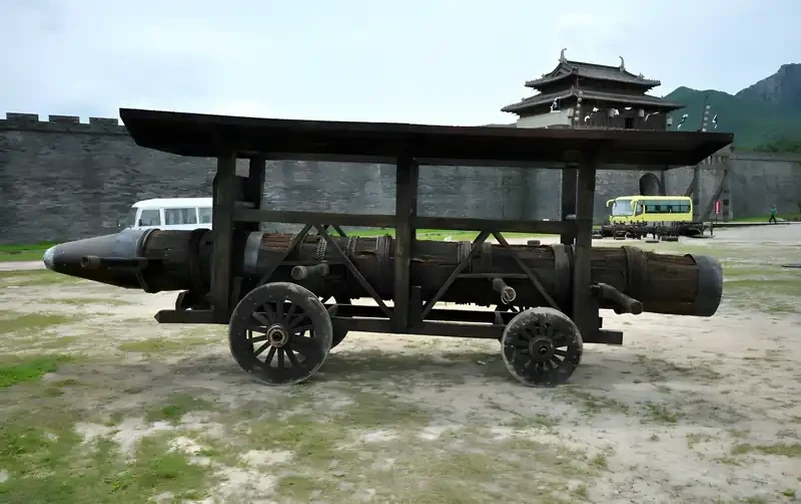
The Wujing Zongyao (Complete Essentials for the Military Classics, 1044, Song dynasty) is why most of these engines look the way they do. Its siege section sets out the yunti (scaling ladder), the paoche (throwing engine), the zhuangche (battering ram) and the chaoche (observation tower), with dimensions, crew numbers and assembly order. What it does not give is a safety envelope, because it was written for soldiers who expected to lose the machine.
The older Kaogongji (Artificers’ Record, in the Rites of Zhou) supplies the number that still governs our chassis: the war chariot wheel is six chi and six cun in diameter, roughly 1.5 m. A replica on that wheelbase sits correctly against a photograph or a mural; a wider one reads wrong even when every other dimension is right, because the eye takes the wheel first.
Where the manuals stop, the show takes over. A film prop needs one good silhouette from the camera side and a hidden brace everywhere else. A theme-park engine needs a silhouette from all four sides and a frame that survives being climbed by an actor in armour. We build both, and the second costs about 30 percent more in timber and 60 percent more in engineering time.
The three prop grades
| Grade | Moving mass | Reset crew and time | Clearance radius | What drives the price |
|---|---|---|---|---|
| Static display | 0 kg, arm pinned | None | 0.5 m | Surface finish, carved detail, plinth |
| Semi-live, winched | 25-60 kg arm | 2 people, 4-6 min | 6 m from pivot | Winch, brake, rope path, guard rail |
| Live-fire, counterweighted | 120-400 kg weight | 3 people, 9-14 min | 12-18 m | Frame section, pivot bushing, release gear, certified rope |
The middle grade is what most parks actually need. A 40 kg winched arm can be re-cocked by two stagehands, reads convincingly on camera, and locks off in seconds if a cue is missed. Live-fire brings the real thud and the dust, and the insurance questions with it.
Load path and the parts that must not be timber
Four parts leave the workshop as metal: the axle shaft, the pivot bushing, the release pin and the rope anchor collar. Frame, arm, bucket, struts and wheels stay mortise-and-tenon hardwood, because that is what makes the silhouette credible. On a semi-live engine we also fit a 6 mm steel plate under the pivot block; without it the repeated shock crushes grain across the bearing and the arm begins to sit low on one side.
Stage safety: envelope, cue line, dead zone
Three numbers go on the stage plan before anything is built. The swing envelope is the arm-tip radius plus 1.5 m for a person who trips. The cue line is where an actor can stand and still read as inside the siege line on camera. The dead zone is the sector the parked arm occupies, which the choreography must never use as an entrance.
For a 7 m arm the envelope is 8.5 m and the cue line sits at 5-6 m, which is why the frame looks oversized on a small stage. Parks that compress this cut the arm, flatten the arc and lose the effect they paid for.
Dead is a design requirement. Between scenes the engine must read as inert: arm locked, rope slack visible, counterweight on the ground, held by a physical pin through the arm collar rather than a brake, so the state is visible from the front row.
Quick changes: eight resets inside eleven minutes
Reset speed comes from three drawing-stage decisions. The bucket is removable, so payload is pre-loaded offstage. The rope runs straight to one winch drum, no sheave to re-thread. The crew works from a marked apron: two footprints at the counterweight, one at the pin, one at the bucket rail, so nobody has to think about position in the dark.
With those three in place a three-person crew completes a full reset in nine to eleven minutes including a rope and pin check. Without them the same engine takes eighteen minutes and needs a fourth person. The cost difference is a few hundred dollars of hardware and one afternoon of layout work.
Freight and crate arithmetic
A 7 m arm engine breaks into frame kit, arm, counterweight box and bucket, and fits a 20-foot container with the arm lashed diagonally. The frame kit is the bulky part: fourteen numbered bays, largest 2.4 m, every piece under 80 kg so two people handle it without a hoist. The counterweight box ships empty and is filled on site with local sand or plate, which keeps freight weight and customs questions down.
Crating follows assembly order: bay 1 to 14 come out in sequence and the pin bag is taped to bay 7, the middle of the build. Experienced crews finish a frame in a day, first-timers in two, which is why every kit carries a numbered photo sequence.
Maintenance between seasons
Every ten shows, check the rope for glazing and the pin for wear. Every fifty, check bushing clearance at the pivot, which should stay under 2 mm. Twice a year, torque the anchor collar and tap-test the joints for loose tenons. Annually, strip the arm, inspect mortise faces for crush, and re-oil with a linseed-tung mix rather than varnish, because varnish traps water in the joint that holds the silhouette.
After the wet season, check the frame feet for standing water. A hardwood post in a drained pit lasts decades; the same post in a pocket that holds water fails in three or four years, and the failure shows as a lean that crews blame on the joints.
Frequently asked questions
Can a working engine also serve as museum display?
Yes, if it is built to the semi-live grade and parked with the arm locked. The extra cost over a static piece buys a machine that can be demonstrated on open days without a second build.
How much does a 7 m arm weigh?
45 to 70 kg in hardwood depending on section. That number decides whether two stagehands can re-cock by hand or the show needs a winch.
Does the counterweight have to be steel?
No. Sealed sand is safer on stage because it spreads the shock instead of concentrating it in one corner, and it can be trimmed on site until the arc matches the choreography.
What is the lead time for a live-fire prop?
Six to eight weeks from signed drawings, of which two weeks are the machined pivot and release parts.
Next step
Send the stage plan, the arm length and the number of resets per night, and we will return the grade that fits, the envelope it needs and a crate list. Compare buying criteria in how to choose a historical chariot before fixing the budget, and read how siege engines are displayed in museums if the same machine has to work as an exhibit part of the year.
Zhongyu Wood Craft, Chongqing. Phone and WeChat: +86 138 8336 6528. Quotes in USD, numbered kits, assembly sequence included.