A museum that decides to build a siege-engine gallery runs into a problem that has nothing to do with history. The objects are large, the gallery doors are not, the freight lift has a load limit, and the touring schedule means the whole set has to come down again in six months. Curators usually discover this after the drawings are approved.
This guide is for the people on the other side of that decision: exhibition designers, touring producers, and museum technical staff who have to specify a full-size Chinese chariot or traction trebuchet that will survive being packed, shipped, installed, struck, and packed again.
What the manuals actually give you
The primary source for most of these engines is the Wujing Zongyao (Complete Compendium of Military Classics, compiled under Zeng Gongliang, 1044). It is not a set of blueprints. It is an illustrated encyclopedia: each engine appears with a description of its function, its crew, and its place in a siege sequence, usually drawn in profile so the mechanism is legible.
That profile view is the reason the book is useful to a fabricator. It tells you the proportion of a cloud ladder’s extension to its base, the position of the counterweight frame on a traction trebuchet, and how a battering ram was suspended so it could swing without tearing its own housing. What it does not tell you is the species of timber, the moisture content, or how to make the same object survive forty crates and three installs.
For timber rules, the second reference is the Yingzao Fashi (Building Standards, Li Jie, 1103), which grades structural timber by span and function and treats joint design as a structural decision rather than a decorative one. A touring replica is a structure first and an exhibit second, and the same logic applies.
Four engines, four different display problems
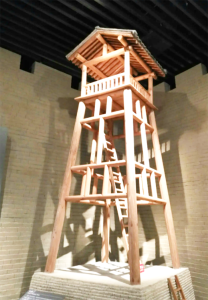
Not every engine belongs in the same gallery. A chariot is a horizontal object that reads from the side; a siege tower is a vertical object that reads from below; a trebuchet is a mechanism that only makes sense when the counterweight is visible; a cloud ladder is a piece of equipment that looks inert until it is extended.
| Engine | Historical role | Typical reproduction | Assembled footprint | Crates | Install crew / time |
|---|---|---|---|---|---|
| Four-horse chariot (si ma zhan che) | Command and missile platform | Two-wheel, single pole, timber box, bronze fittings | 3.1 x 1.6 m | 3 | 2 people / 2 hours |
| Siege tower (chao che) | Elevated observation and archery platform | Wheeled frame, lattice mast, removable shield wall | 3.0 x 3.0 x 6.5 m | 6 | 3 people / 5 hours |
| Battering ram (zhuang che) | Wall and gate breach | Suspended log ram, roofed housing, four wheels | 4.2 x 1.8 m | 4 | 2 people / 3 hours |
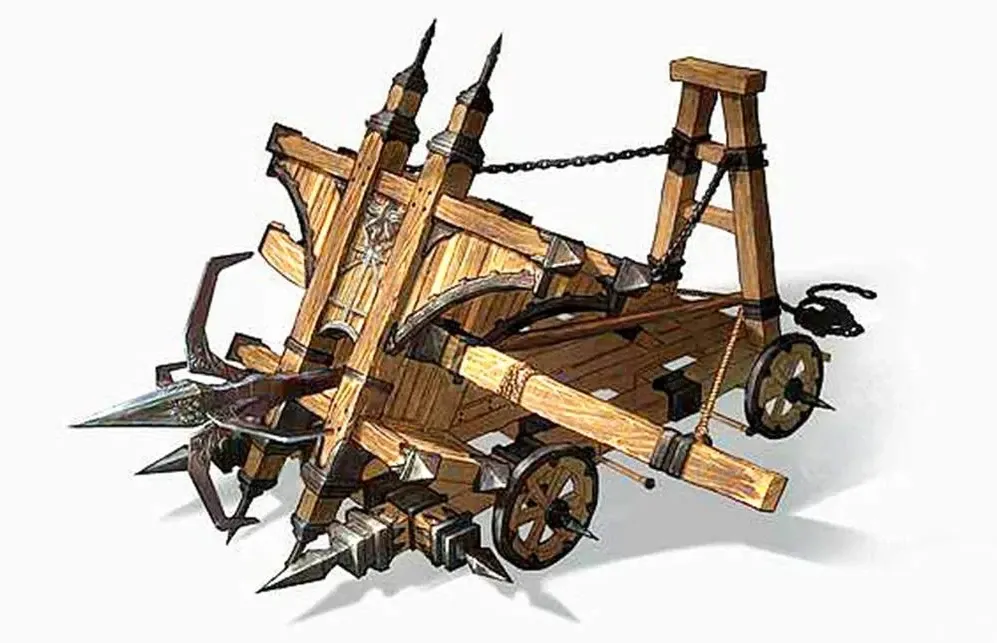
| Traction trebuchet (pao che) | Indirect fire over a wall | Counterweight or crew-pulled beam, braced A-frame | 2.6 x 3.4 m | 4 | 3 people / 4 hours |
Dimensions above describe a standard build for gallery use. Final figures follow the approved drawing, because a chariot sized for a four-horse team and a chariot sized for a single-horse display are different objects with different crate plans.
The frame decisions that decide whether it survives a tour
Species and moisture. Larch and Scots pine are the practical choices for large frames: stable, available in long sections, and predictable after kiln drying. Whatever the species, the moisture content has to be equalized before machining, or the joints will open in a climate-controlled gallery that sits at 45 to 55 percent relative humidity.
Joints. A mortise and tenon is the correct joint for the object’s historical logic, and the wrong joint for a touring object if it is glued shut. The workable compromise is a pegged mortise and tenon: the joint is cut as the original was cut, but the peg is removable so the frame can be taken apart into crate-sized subassemblies. Hidden steel connectors are acceptable on structural nodes that are never exposed, and they should be documented on the assembly drawing so the next venue does not mistake them for historic fabric.
Wheel loads. A six-metre siege tower on four wheels puts a point load on a gallery floor that a marble or terrazzo surface may not tolerate. Specify wheel diameter, tyre material, and a load-spreading plate per wheel. For a display that never rolls, the wheels can be blocked and the load transferred to a plinth through the frame.
Moving parts. Trebuchet beams and ram suspensions should be locked out for display and released only for demonstration. A beam that swings during installation is a safety incident, not a feature.
The crate is part of the object
Touring exhibitions fail at the crate, not at the gallery. Every subassembly needs a number that appears in three places: on the part, on the assembly drawing, and on the crate manifest. A crate that holds four different parts without a loading diagram guarantees a slow install and a damaged edge.
Practical rules that save the most time: crate each subassembly to its assembled outside dimension plus 60 mm; brace long beams diagonally rather than filling the void; keep all hardware in one labelled case per engine rather than distributed through the crates; and photograph the packed crate from the top before it is closed, then put that photograph in the manifest folder. The photograph ends more arguments than any drawing.
Assembly on a gallery floor
The sequence below is the one that keeps a three-person crew inside a single working day for a chariot or a ram, and inside two days for a tower.
Lay out and verify.Open the manifest, place the numbered parts in assembly order, check the crate count against the manifest before touching a tool. Base first. Assemble the wheel frame or plinth on the floor, level it, and confirm the load path before any vertical member goes up. Verticals in pairs. Raise two opposing uprights with temporary bracing, then the cross members. Never leave a single upright free-standing overnight. Fit the mechanism. Install the beam or ram suspension with the lock engaged, then release it only under control. Dress and verify. Attach shield walls, fittings, and labels last; walk the object once for loose hardware, then hand it to the registrar.
Climate, pest, and the maintenance calendar
Timber in a gallery moves with the room. Two readings matter: relative humidity and its rate of change. A stable 50 percent plus or minus 5 percent is kinder to a large frame than a perfectly dry room that swings twenty points between day and night.
Inspect joints and pegs at every rotation, not every year. Look for crushing at the tenon shoulder, which is the first sign of a frame that is carrying more load than it was designed for. Keep a small kit with the object: spare pegs, a wax stick for exposed end grain, a torque wrench for the structural connectors, and a printed copy of the assembly drawing. The kit costs less than one service visit.
Frequently asked questions
Can a full-size chariot be installed through a standard gallery door? Usually yes, if the box and the pole are separate crates and the wheels are removed. The crate plan has to be designed against the door and lift dimensions from the start, not after the object is built.
Do you build to a museum drawing or to the historical illustration? Both, in sequence. The illustration sets proportion and mechanism; the museum drawing sets the footprint, the floor loading, and the barrier distance. Where they conflict, the gallery wins and the difference is documented.
How long does a touring set take to produce? A four-engine set with drawings, crates, and manuals typically runs eight to twelve weeks from approved drawings, with the crate plan finished before production starts.
Is the finish appropriate for handling? Objects that visitors may touch get a hard wax and oil finish rather than a film-forming coating, so a scuff can be repaired locally instead of requiring a refinish.
Can the same set be used outdoors? Not without a separate specification: drainage, UV protection, and fastener detailing all change.
If you are planning a siege-engine gallery or a touring set built around a Chinese chariot, a copy of our chariot and siege-engine work shows the joints, crate plans, and manuals we deliver with each unit. Send the gallery height, the door and lift dimensions, and the number of venues on the tour, and you will get a dimensioned proposal with a crate plan attached. For related reading on how traditional water machinery was built and maintained, see this study of ancient waterwheels.
Zhongyu Wood Craft, Chongqing, China. Heritage timber work since 1978. Telephone and WhatsApp: +86 138 8336 6528.