Most public gardens do not have a signage problem. They have a sequencing problem: the map at the gate was bought in one budget year, the plant labels in another, and the direction fingers were added by whichever department last had money left over. Visitors experience all three as a single system, and judge it as one.
Yuan Ye (The Craft of Gardens, Ji Cheng, 1631) opens with the argument that a garden must be laid out according to its site, xiangdi, before anything is built. Wayfinding is the modern version of the same discipline: the route is decided before the furniture, and the signs are the last, smallest part of the route. Get the route right and modest signs work. Get it wrong and no sign budget will fix it.
Five sign types, five different jobs
Almost every municipal tender bundles these into one line item, which is why so many parks end up with signs that do several jobs badly instead of one job well.
| Type | Job | Typical size | Reading distance | Material logic |
|---|---|---|---|---|
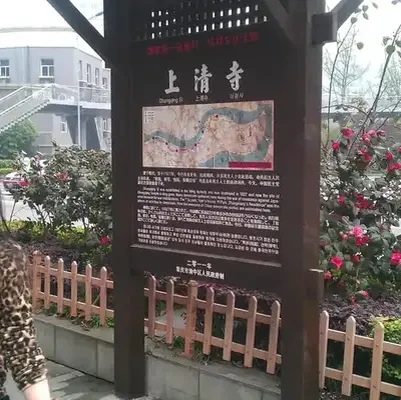
| Gate orientation panel | One decision: where am I, which way to the main loop | 1,200 x 800 mm | 2-4 m | Timber frame, printed aluminium face, vandal-resistant fixings |
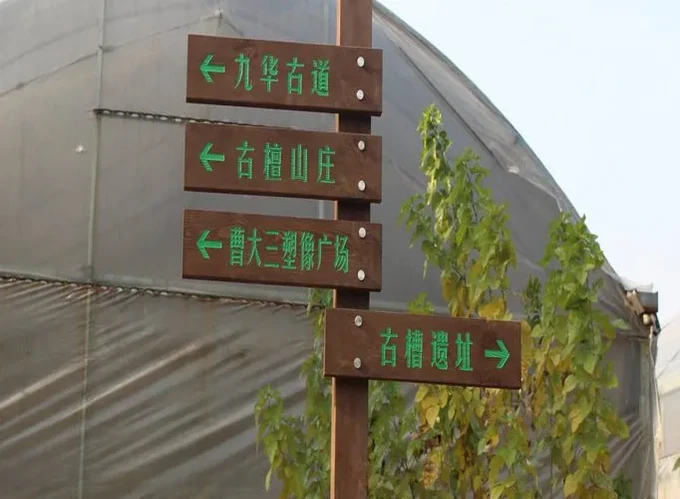
| Direction finger | One destination, one arrow, low text volume | 700-900 mm arm | 5-10 m | Solid timber arm with routed lettering or applied plate |
| Interpretive panel | Why this plant, why this water, what happened here | 600 x 400 mm | 0.8-1.2 m | Timber post, sloped face, replaceable printed board |
| Regulatory sign | One prohibition or instruction, legally defensible | 200-300 mm | 1-3 m | Metal or composite; timber only as a decorative surround |
| Trail marker | Confirms you are still on the route | 100-150 mm | 1-2 m | Durable small timber or composite marker at knee height |
The sizing rule that matters is not aesthetic. Cap height drives legibility: roughly 25 mm of letter height per 3 m of viewing distance for a visitor with normal sight, and about double that for visitors with low vision or for signs read from a moving path. A finger sign read at 8 m needs 60-70 mm capitals, which is why so many park signs fail: the lettering was set at the size the designer liked on a screen, not the size the distance requires.
A timber direction sign at a park bridge crossing: the post section is standardised, the panel is replaceable, and the fixings are slotted so the panel can move with the seasons.
Timber in a public landscape: what actually fails
Timber signage in parks fails in four places, and three of them are details rather than materials.
The post base. A post rots first at the ground line, where wetting and drying alternate. A 300 mm gravel collar around the base, draining to the surface, adds years to the sign’s life for the cost of a bucket of stone.
The joint between post and panel. Differential movement between a wide panel and a narrow post opens the fixing holes. Slotted holes and stainless stand-offs let the panel move without tearing the post.
The face. Direct-printed timber faces fade unevenly because grain density varies across the board. A printed aluminium face on a timber frame keeps the material warmth and gives the print a stable substrate.
The eave shadow. Signs placed under dense canopy stay damp for weeks. Move them 500 mm out from the dripline, or accept a two-year repaint cycle.
Specifying timber species without over-specifying
Three species cover almost every municipal need. Thermally modified ash is dimensionally stable and needs no biocide, which makes it the easiest specification to defend in a public procurement document. Larch is the workhorse for posts and arms, cheap and honest, and it greys gracefully if the client accepts a natural finish. Oak belongs on gate panels and feature signs where the sign is part of the architecture, not on plant labels where it will be replaced in five years.
What matters more than species is the finish system. On anything vertical and exposed, an oil finish that can be renewed every two to three years beats a film finish that fails in one go. On anything the public touches, no biocidal preservative on the outer surface: specify a species and a detail that do not need it.
Who signs off, and why that decides the design
Municipal signage passes through four different reviewers, and each one is looking for something different.
The landscape architect wants the sign to disappear into the planting and reappear when needed, which usually means muted colour, low profile, and no reflective face.
The maintenance team wants a sign that can be cleaned with a hose, repaired without a workshop, and replaced without closing a path.
The accessibility reviewer wants contrast, height, and a tactile or audio option at key nodes.
The procurement officer wants a specification that can be tendered without naming a single supplier.
A design that satisfies all four is usually smaller and more modular than the first proposal: shorter text, replaceable panels, standard post sections, and a colour palette of two.
Installation sequence that avoids rework
Set posts after the path edging is final, never before, because a post set to a provisional edge will be 200 mm wrong by handover. Use a post anchor that allows the sign to be re-plumbed after the ground settles, and leave the top 100 mm of the post uncoated until the final inspection, so any damage from machinery is visible and repairable.
Commission in the rain. It sounds like a joke and it is not: water on a sloped interpretive face is the fastest way to find out that the panel was set at the wrong angle.
Maintenance that fits a real budget
Two visits a year, one before the visitor season and one after it. Check post bases for movement, clean drainage collars, replace any panel that has faded past legibility, and re-oil the surfaces that face the weather. Keep a stock of the three most common panels in the maintenance store; replacing a panel in a week costs less than the complaints generated by a wrong direction for a season.
Frequently asked questions
Can timber signage meet public accessibility rules? The timber is the frame; contrast and letter height come from the face and the artwork. Specify the face separately and accessibility becomes a print decision rather than a material one.
What is the realistic service life? Eight to twelve years for a larch post with a gravel collar and an oil finish, longer for thermally modified ash, less under dense canopy without an air gap.
Can we add signs later without a redesign? Only if the system is modular from the start: one post section, one panel size, one fixing. That is a decision made at the first tender, not at the fifth.
Do you supply the artwork? We supply templates with the correct cap heights for each viewing distance and the panel outlines; the mapping and copy stay with the client or the landscape architect.
How is it shipped? Posts and rails in one crate, panels in a second crate with the printed faces protected, and a numbered location schedule that matches the site plan.
For signs combined with ticket booths and park furniture, see our scenic facility signage and ticket booth range. For the larger timber elements that usually sit at the same nodes, read this article on sizing and fixing an antique-style plaque. Send the site plan, the path widths, and the number of nodes, and you will get a modular sign schedule with quantities and a crate plan.
Zhongyu Wood Craft, Chongqing, China. Heritage timber work since 1978. Telephone and WhatsApp: +86 138 8336 6528.
Call/WhatsApp: +86 13883366528
Zhongyu Woodcraft – 48 Years Traditional Chinese Woodcraft Factory, Nationwide Installation