Timber Surfaces in an Ancient Town: Why New Wood Reads Wrong
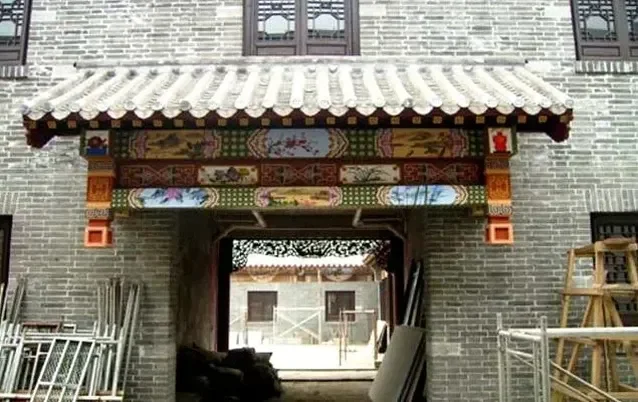
A rebuilt street frontage can be structurally correct and still be rejected at the review meeting, because the eye reads surface before it reads detail. On a recent lane project, the difference between the approved and the rejected elevation was one decision: a 0.9 m sample board of stained timber placed beside untreated new pine. At 30 m, the untreated board was a pale stripe against grey masonry; the stained board sat inside the street’s tonal range and the joinery stopped shouting.
This article deals with that decision — the finish — and the four options we quote for ancient-town and rural renewal work, with what each costs to hold for ten years.
What the old manuals fix, and what they leave to the builder
Yingzao Fashi (1103) sets member size by rank through the cai-fen system of eight grades, which means the visual weight of a bracket or a rail is a function of hierarchy rather than taste. Yuan Ye (1631) argues siting before construction, and its idea of borrowed scenery explains why a new timber element in an old lane has to disappear into the existing view instead of competing with it. Luban Jing works in bay spacing and proportion rules for ordinary buildings, the scale most renewal projects actually build at.
None of these texts specifies a finish. They set proportion and siting; the surface is the modern builder’s problem, and it is where most review meetings are lost.
The four finishes we quote
| Finish | How it reads at 20 m | Service life outdoors | Recoat interval | Relative cost index | Best use |
|---|---|---|---|---|---|
| Untreated pressure-treated pine | Pale, uniform, visibly new for 18-24 months | 8-12 years structural, greying early | None, but greys unevenly | 1.0 | Hidden structure, temporary works |
| Thermally modified timber | Even mid-brown, low sheen, no grain contrast | 15 years and longer | Oil every 3-4 years | 1.6 | Street furniture in daily sun and rain |
| Pigmented tung-oil stain | Deep brown with grain visible, sits inside old masonry tones | 10-12 years with recoating | Every 2-3 years | 1.2 | Visible façades, shopfronts, corridor rails |
| Distressed and reclaimed look | Patina, uneven edges, reads as inherited fabric | Dependent on substrate, 10 years plus | Spot repair only | 1.8-2.4 | Feature pieces where new build must not show |
The cost index is relative to untreated pine on the same section, materials and labour included. It is not a price list; it is the shape of the argument you will have with a project cost consultant.
Why “new wood” reads wrong, in three mechanisms
1. Value contrast, not colour
Fresh pine is high-value and low-saturation: it reflects more light than aged masonry, brick or grey render. The fix is not a darker paint; it is a finish that brings the timber’s reflectance into the range of the wall behind it.
2. Grain scale
Modern planed timber shows a wide, regular grain at a scale the old lane does not contain. Staining alone will not fix this. Either the section is re-detailed with a smaller member, or the surface is wire-brushed to break the machine regularity.
3. Joint visibility
New bolts and plates read as new. On visible façades we specify pegged tenons and hidden stainless fixings, and we leave the peg heads slightly proud so the joint reads as a joint rather than a shadow.
The sample board protocol
Every renewal project should approve finish on a board, not on a colour chip. Our protocol:
Make it 0.9 m, not 0.2 m
A small chip hides grain and sheen. A 0.9 m board shows the member at the width it will be built.
Judge at three distances
Two metres for texture, ten metres for elevation reading, thirty metres for the street view a visitor actually has. A finish that passes at two metres often fails at thirty.
Judge in two lights
Overcast and midday. Overcast flatters everything; midday exposes sheen and patchiness. Approve only on the worse of the two.
Installation sequence that protects the finish
Most damage to a stained surface happens after the staining, during installation. The sequence we insist on:
Finish before site, repair after
Boards are stained in the workshop, dried, then packed with interleaving. Site touch-up is limited to cut ends and peg holes.
No wet bedding
Posts go into a gravel or sleeve detail, never directly into saturated ground. A post sitting in water wicks moisture up the member and pushes the stain off from the base.
Handover checklist
At acceptance, record: stain batch, date of application, coat count, moisture reading of the substrate at application, and a photograph of each elevation in flat light. That record is what makes a ten-year warranty arguable.
Maintenance, stated plainly
Pigmented tung oil needs a recoat every two to three years on horizontal surfaces and every three to four on verticals. Thermally modified timber needs less often but cannot be left bare forever; without oil it greys. Distressed work needs spot repair only, which is the reason it is specified where a project cannot afford a visible maintenance cycle.
The maintenance sheet also has to name who does it. A finish with an unnamed maintainer is a finish that fails in year four and gets blamed on the supplier.
Frequently asked questions
Can we match an existing grey-brown?
Yes, with a pigmented stain matched to a physical sample from the site, not to a photograph. Send a 100 mm offcut of the old member and we will return three candidates.
Is pressure-treated timber acceptable in a heritage zone?
Often yes for structure that is not seen, and rarely for visible façades. The treatment should be disclosed in the specification either way.
How long before a new street stops looking new?
Untreated pine takes 18 to 24 months to grey, unevenly. A stained finish looks settled from day one, which is the reason renewal projects pay the premium.
Do we need a full mock-up façade?
Not usually. One 0.9 m board per finish plus one full bay of railing is enough to approve both colour and joint detail.
Where this connects to the rest of the street
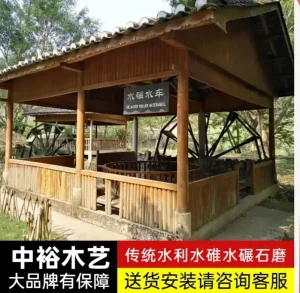
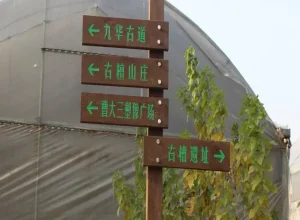
Surface decisions rarely stop at railings. Signboards, corridor rails and pavilion frames all sit in the same view, and if they are finished separately the street reads as a patchwork. Our notes on moisture limits for covered corridors explain the structural side of the same problem, and the teak wayfinding and signboard system page covers the visible signage layer that usually shares the finish.
Scene consultation
If a renewal package needs one finish language across railings, signboards, corridor frames and pavilion structures, send the elevation drawings and a site photograph. We will return a finish schedule with sample-board instructions and a ten-year maintenance estimate. Scene consultation for ancient-town and rural renewal: timber signage and finish specification, or call +86 138 8336 6528.