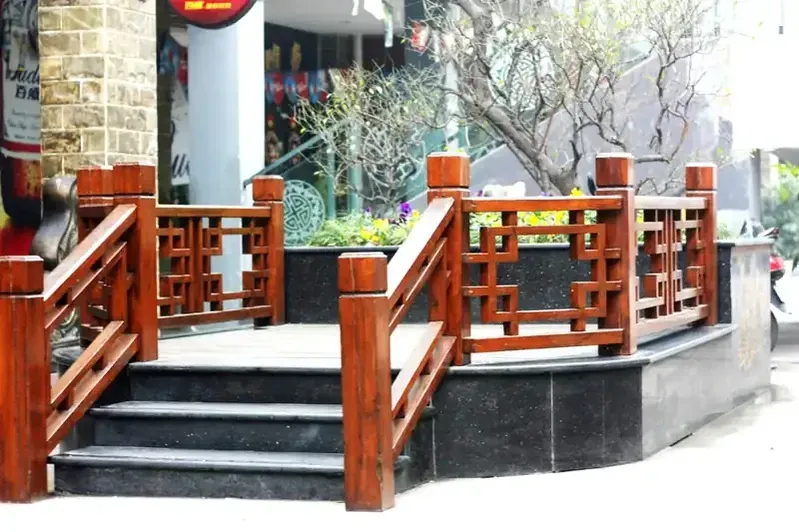
A wooden planter box is more than a garden accessory; it is a structural challenge requiring mastery over timber durability. In the pursuit of sustainable timber architecture, traditional joinery from China offers a superior alternative to modern steel fasteners. This guide explores how the ancient Chinese philosophy of interlocking joints applies to modern outdoor landscape planters, creating structures that withstand the elements for decades.
Historical Roots in Eastern Landscaping
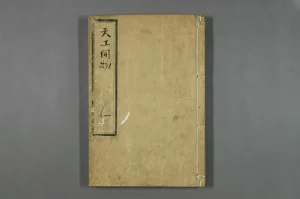
The practice of elevating soil containers in traditional Chinese gardens dates back to the Song Dynasty. As recorded in the Tiangong Kaiwu, woodworkers developed specific techniques to handle the moisture of soil, recognizing that raw timber would rot in contact with earth. Early landscape planters utilized natural oils and precise drainage systems. The Yingzao Fashi (Building Standards) provides early documentation on how to select hardwoods for outdoor exposure, prioritizing density and natural resistance over aesthetic grain alone. These historical foundations inform how modern anti-corrosion wood projects are designed today, bridging centuries of botanical and engineering knowledge.
The Craftsmanship of Interlocking Joints
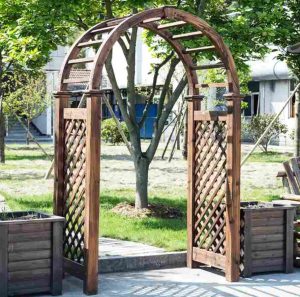
Modern mass-produced flower boxes often rely on screws, which create weak points for water infiltration and structural failure over time. In contrast, a professional anti-corrosion wood manufacturer utilizes mortise-and-tenon joinery. This method allows wood to expand and contract naturally without the rigidity of metal. Our senior craftsman with 48 years of experience says that the tightness of the fit matters more than adhesive; the geometry of the joint provides the strength. By interlocking the top and bottom rails, the structure resists racking, maintaining its shape even after years of thermal stress. This craftsmanship is visible in the clean lines of a high-end garden arch or vertical planter, where the woods integrity is the primary support system rather than hidden hardware.
Material Selection for Durability
The core of any outdoor landscape planter is the material. We treat softwoods using a pressure-impregnation process that forces preservatives deep into the cellular structure of the timber. This extends the functional life of a wooden flower cart or deck box to 15 years or more. We compare materials based on their moisture content stability. The table below highlights the performance differences between standard pressure-treated pine and carbonized wood.
| Material Type | Expected Lifespan | Best For | Cost Factor |
|---|---|---|---|
| Pressure-Treated Pine | 10-12 years | Standard flower boxes | Low |
| Carbonized Wood | 15-20 years | Prestige landscape features | Medium |
| Hardwood (Ipe) | 25+ years | Commercial high-traffic areas | High |
Choosing the right timber ensures that your anti-corrosion wood project does not fail prematurely due to warping or rot. This data is essential for clients looking to balance budget with longevity in their outdoor designs.
Applications in Urban Green Spaces
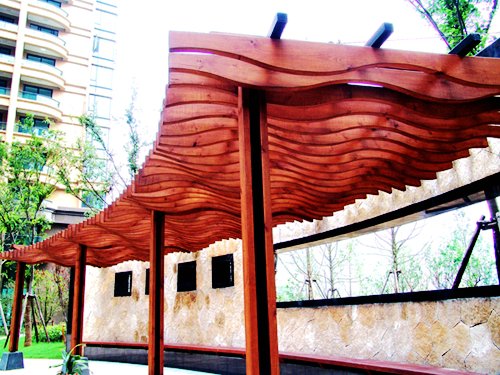
The global push for a green city has made modular landscape planters a staple of commercial street renovation. Architects in various regions now specify custom combination planters to break up the visual monotony of concrete pavement. These planters are not just for flowers; they support the weight of soil and root systems for larger shrubs. A well-designed vertical planter maximizes square footage in tight courtyard spaces, while a large boardwalk section can serve as an integrated raised garden. The versatility of wood allows designers to match the material with natural surroundings, softening the hard edges of urban infrastructure without losing structural integrity.
Customization and Structural Safety
Standardization is rarely enough for high-end landscapes. Clients frequently request specific dimensions, such as a 3-meter wide planter with a 45-degree bevel to match existing architectural lines. The weight of the soil load is a critical factor. A typical combination planter filled with standard potting mix can weigh over 500 kg. Therefore, the base structure must be reinforced to handle this static load on level ground. We ensure that all joints are cut to a tolerance of less than 1 mm, ensuring the box remains square and flat during assembly. This level of precision is a mark of a specialized anti-corrosion wood manufacturer rather than a general carpentry shop.
Case Study: The Heritage Park Project
In a recent commission for a heritage site, the client required a row of 10 large, rectangular planters to support climbing vines without damaging historic brickwork. We engineered a steel-core base hidden within the timber to distribute the root weight, while the outer shell featured traditional joinery details. The installation was completed in just 20 days, and three years later, the timber shows zero signs of moisture intrusion. This success relied on the principle that beauty in a wooden flower cart or landscape planter must be backed by invisible engineering. The result was a space that felt centuries old while performing with modern reliability, proving that traditional methods can solve contemporary urban challenges.
Frequently Asked Questions
Q: How long does a wooden planter box actually last?
A: A properly treated pressure-treated wooden planter box lasts 10-12 years, while carbonized or hardwood versions can easily reach 20 years with minimal maintenance.
Q: Can I build a vertical planter with standard joinery?
A: Yes, but the tenon joints must be reinforced with through-bolts because vertical loads are different. Our engineering team designs these specifically for weight distribution.
Q: What is the best wood for a flower box?
A: For most climates, pressure-treated pine offers the best value. For high-end, low-maintenance designs, a landscape planter made from carbonized wood is the superior choice.
Conclusion
The intersection of traditional joinery and modern horticulture creates a functional art form. By understanding the history and engineering behind the interlocking joints, you can select a landscape planter that serves as a lasting asset rather than a temporary decoration. Whether for a private garden or a public space, choosing a structure built on 48 years of expertise ensures that your wooden planter box will remain robust and beautiful for decades.
Customizing Dimensions and Wood Species for Microclimates
Standard planter boxes often fail in specific environments because they ignore local microclimatic factors. At Zhongyu Wood Art, we treat every custom order as an engineering challenge tailored to your specific site conditions. For high-altitude locations in the across China or across China regions, where UV radiation is intense and temperature fluctuations are sharp, we recommend upgrading from standard pine to premium teak or acacia. These species contain natural oils that resist swelling and shrinkage, preventing the micro-cracking that typically destroys standard hardwood planters within three years. We utilize a kiln-drying process that reduces moisture content to 12%, ensuring dimensional stability before the wood is cut.
Beyond species selection, precise dimension customization is critical for load-bearing integrity. A planter intended to hold heavy stone-filled soil or large ornamental trees requires a base structure reinforced with 15mm thick cross-bracing. Our CNC machines cut these joints with a tolerance of ±0.5mm, allowing for a tighter fit that resists loosening over time. For vertical garden installations on building facades, we offer modular interlocking systems that distribute weight evenly across the wall structure, eliminating the need for invasive anchor points into the main masonry. This modular approach also allows for future expansion, enabling you to add sections as your garden grows without replacing the entire unit.
Material Option 1: Accoya Modified Wood.A sustainable alternative to tropical hardwoods, Accoya is modified with acetic acid to create a closed-cell structure that is immune to fungal decay. It retains its natural light color without the need for frequent repainting, making it ideal for high-maintenance public spaces in China or across China. Material Option 2: Composite-Wood Hybrid. For coastal environments where salt spray is a primary concern, we offer a hybrid design using a concealed composite outer shell with a solid timber inner frame. This prevents the rapid degradation of wood exposed to chloride salts while maintaining the aesthetic warmth of natural timber. Load-Bearing Spec. Each planter is rated for a soil weight of up to 2.5 tons. Our engineering team calculates the ground bearing pressure for your specific site to ensure the planter does not sink or tilt during heavy seasonal rainstorms.
Preservation Protocols: Ensuring Decade-Long Structural Integrity
The longevity of a wooden landscape asset depends less on the initial material quality and more on the preservation protocols applied during fabrication. A common error in the industry is applying surface paints that seal the wood, trapping moisture inside the fibers. This trapped moisture leads to internal rot that remains invisible until the structure collapses. We advocate for open-pore penetration treatments rather than surface coatings. Our in-house facility uses pressure-impregnation chambers to inject water-repellent waxes deep into the cellular structure of the timber. This method allows the wood to “breathe,” maintaining equilibrium with ambient humidity levels while repelling liquid water.
For public installations, we implement a dual-layer protection system. The primary layer is a UV-stable penetrating oil that darkens the wood to a rich bronze hue, protecting it from solar degradation. The secondary layer involves micro-porous ceramic coatings applied to the exposed vertical faces. This coating creates a sacrificial barrier that can be refreshed every five years, extending the total lifespan of the planter to 30 years or more. We provide a detailed maintenance schedule with each delivery, specifying the exact products to use and the optimal seasonal timing for application. In colder climates like those in Northern China or Europe, this schedule includes a freeze-thaw cycle test protocol to ensure the joints remain tight even after 50 cycles of freezing and thawing.
Furthermore, we integrate drainage and aeration systems directly into the planters geometry. Instead of simple drilled holes, we use angled drainage channels that direct water away from the structural feet, preventing capillary rise which is a primary cause of wood rot at the base. These channels are capped with removable grilles that allow for easy inspection and cleaning of root intrusion. This engineering focus ensures that the planter remains structurally sound long after the soil has settled and the plants have matured.
Installation Logistics and Project Management
Related Articles
Related Articles
Ancient War Chariot Replica: Historical Chinese Siege EngineHow Film City Buyers Find Waterwheel CustomizationFor pricing, custom size requests, or delivery time to your region, contact our team directly we reply within 24 hours with a detailed quotation and shipping estimate.
Call/WhatsApp: +86 13883366528
Zhongyu Woodcraft – 48 Years Traditional Chinese Woodcraft Factory, Nationwide Installation