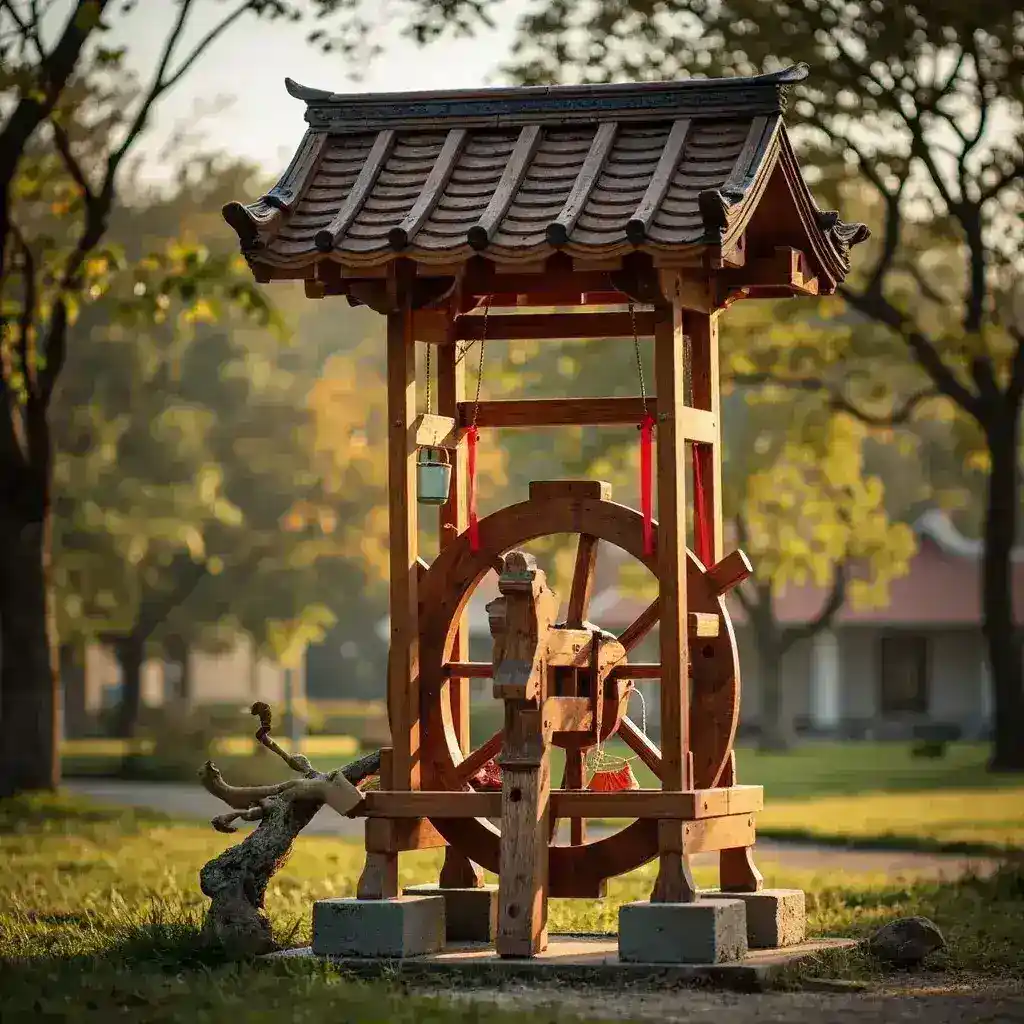
A garden waterwheel should be winterised by draining the trough and freeing the paddles, not by wrapping the wheel in tarpaulin. Ice is the problem: it adds load where the wheel was never designed to carry it, and it holds water against timber that needs to dry.
What happens to a timber waterwheel at the first hard freeze?
Three things happen within a few days of the first hard freeze. Water left in the trough expands as it turns to ice and pushes outward against boards that were designed to hold water in, not to resist pressure from inside. Ice bonded to paddles adds an uneven mass, so a wheel that was balanced at 600 to 900 kg becomes a wheel with a heavy sector. And the freeze-thaw cycle keeps the frame at a moisture content above the 12 to 15 percent we hold at assembly, which is the condition in which joints move.
The visible damage usually appears in spring, which is why winter work matters. A trough board split in January looks like a spring failure in April, and by then the repair is a rebuild rather than a patch.
Which components fail first in winter?
| Component | Winter failure mode | Preventive action |
|---|---|---|
| Trough and inlet channel | Ice expansion splits boards; debris blocks the inlet, then freezes | Drain before the first forecast of -3 C; clear leaves and gravel |
| Paddles | Ice build-up unbalances the wheel; a struck paddle cracks at the spoke joint | Never start a wheel with ice attached; remove ice by hand |
| Shaft and bearings | Water ingress, grease washed out, shaft rusts at the collar | Grease before shutdown, cover the bearing housing, check runout in spring |
| Frame and posts | Snow load on the roof, wet feet, frost heave at the pad | Clear snow with a wooden or plastic blade; keep the pad drained |
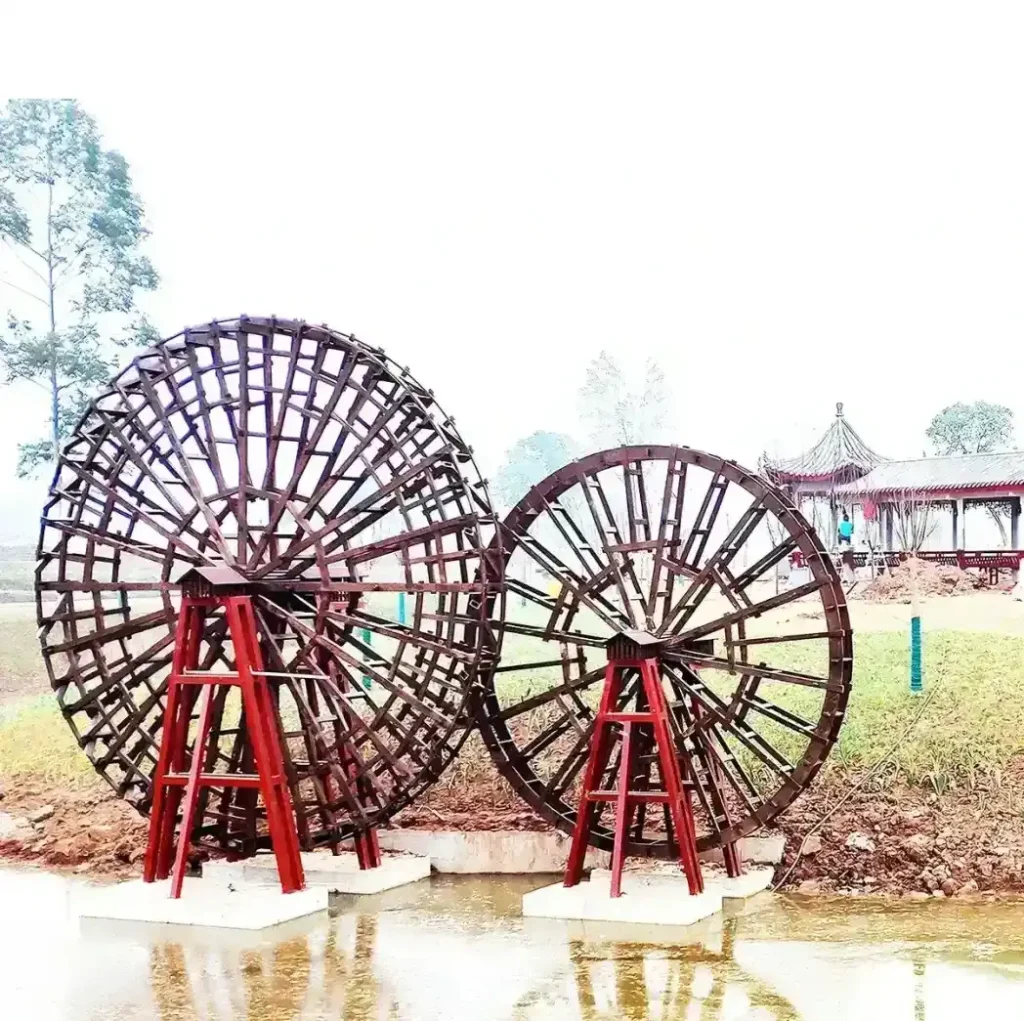
On a 4.2 m wheel with paddles at roughly 0.33 m pitch, that is about 40 paddles, and each one is a place where ice can grip. A wheel of that size carries a 0.9 m working width on a 2.6 m axle height, so the lower paddles sit close to the water line where spray freezes first.
Should the wheel be drained or kept running?
It depends on climate, and the decision should be written into the operating manual rather than left to the ground staff.
| Climate | Winter regime | Reason |
|---|---|---|
| Hard freeze, weeks below 0 C | Drain trough, stop and lock the wheel, cover bearings | No standing water to freeze; no ice load on paddles |
| Mild frost, daytime above 5 C | Keep a low flow running overnight, inspect daily | Moving water resists freezing; a trickle prevents a solid block |
| Indoor or covered installation | Normal operation, humidity control | No ice load; watch condensation instead |
Draining is not the same as abandoning. A drained wheel still needs its shaft greased, its joints inspected and its guard checked, because the structure is now cycling through dry frost rather than standing in water.
What did the old irrigation manuals specify?
Nongzheng Quanshu (1639), in the irrigation plates of juan 17, sets out lifting devices as families of parts rather than single machines: a frame, a wheel or a chain of boards, and a driving element. The same plates describe the dragon-bone chain pump and the vertical wheel with buckets, which is the ancestor of the decorative wheel most gardens install today.
What the manual gives a modern maintainer is a way to think about the machine: each part has a season, and the part that holds water is the part that suffers first. That is still true of a park installation with a motor, a VFD and a guard fence.
How do you restart a wheel in spring?
Clear the trough and inlet by hand; do not run the wheel to flush debris. Check the shaft for runout and re-grease the bearings before the first turn. Inspect every paddle joint; tap suspect wedges and replace cracked boards. Fill slowly and watch the trough for leaks at the joints before reaching full flow. Run by hand for two revolutions, listening for a scrape at the guard line. Start the motor at the lowest setting and confirm the stop ramp; a 1.5 second ramp-down keeps the wheel out of the guard. Hold demonstration speed between 8 and 12 rpm for the first week.
If the wheel is motorised, test the emergency stop with the trough half full, not empty. The failure a risk assessment cares about is a wheel that coasts after the stop command, and that behaviour only appears under load.
What maintenance does a public garden wheel need each season?
| Season | Task | Record |
|---|---|---|
| Spring | Restart checklist, joint inspection, guard check | Runout reading, paddle count replaced |
| Summer | Clear algae and debris, oil exposed timber, check flow rate | Flow, oil product and date |
| Autumn | Clear inlet, grease bearings, photograph all paddles | Photo set for the winter comparison |
| Winter | Drain or low-flow regime, remove ice, clear snow | Shutdown date, frost depth, damage notes |
A photograph set in autumn is the cheapest diagnostic tool a garden has. It shows whether a paddle has moved, whether a joint line has opened, and whether the colour change is surface or structural.
Does winter care change the specification when buying a wheel?
Yes, and it is worth raising at the drawing stage. If the site freezes, ask for a trough with a drain plug at the low end, paddle fixings that can be replaced without dismantling the wheel, and a bearing housing that can be greased from outside the guard. Those three details cost little at production and a great deal later.
For cold-climate sites we also recommend a hand-turning tier for the winter months: the wheel stays legible as an object, staff can rotate it for photographs, and no motor is started with ice attached. The hand tier packs to about 8 m3, which leaves room in a 20-foot container for a second small structure; the motorised tier at 10 m3 fills a container once the control cabinet is added.
Frequently asked questions
Should a garden waterwheel be covered in winter?
Usually no. A cover traps moisture and hides ice build-up. Drain the trough, free the paddles, protect the bearings and leave the wheel visible for inspection. Cover only the motor and control cabinet, and ventilate that cover.
Can the wheel be left turning in freezing weather?
Only with a continuous flow and daily inspection. Moving water resists freezing, but a stopped flow on a cold night can lock the wheel solid. If the site cannot guarantee flow, drain and lock it instead.
How much does ice load matter on a 4.2 m wheel?
It matters as imbalance rather than as total weight. Ice on one sector turns a balanced wheel into a heavy side, and the shaft and paddle joints take that load every revolution. Remove ice before running, never during.
What is the lead time for a replacement trough?
A trough section is a small production item, typically three to four weeks plus freight, and it ships in the same crate system as the original. Send the serial number and the measured section length; the drawing set is kept for repeat parts.
Do you supply an operating manual for winter shutdown?
Yes. Each wheel ships with a maintenance sheet that includes a winter section, the drain points, bearing locations and a paddle map numbered to the drawing, so the ground staff can record replacements against the right position.
Specifying a waterwheel for a park or botanical garden? Send the pond dimensions, winter climate and viewing distance for a wheel size and a trough detail. Call/WhatsApp: +86 138 8336 6528. Product reference: custom heritage waterwheel, factory direct. For the axle and touring decisions behind a 1:1 wheel, read why the axle decides whether a museum waterwheel can tour.