A private courtyard pavilion fails its finish test in year three, not year one. Choose the schedule by how the timber will be exposed, not by how the sample looks in a showroom: a shaded, irrigated garden and a wind-exposed roof terrace need different surfaces, and one of them will need re-oiling twice as often.
What does a private courtyard pavilion actually need from its finish?
A garden pavilion in a residential courtyard needs three things from its surface: dimensional stability through wet and dry cycles, a colour that still reads as timber after five summers, and a recoat routine a homeowner can actually complete. Everything else, including the exact sheen, is a design preference.
In our 48 years of building traditional timber structures, the failures we are called back to inspect are almost never structural. They are surfaces: a softwood post that has greyed into a patchwork, a rail whose film coating cracked along the joint line and trapped water, or a planter box whose interior was never sealed because the spec stopped at the outside face.
Three numbers should be fixed before the finish is selected. Bay spacing of 2.6 to 3.0 m and eave height of 2.45 to 2.75 m set how much surface faces the weather and how accessible it is for maintenance. Assembly moisture of 12 to 15 percent decides whether the joints stay tight; timber fitted wet will shrink away from a tenon and open a line you can see from across the garden. The third number is the recoat interval the owner will tolerate, and it should be written into the specification rather than discovered later.
Which three finish schedules do we quote most?
| Schedule | Best for | Recoat cycle | Watch point |
|---|---|---|---|
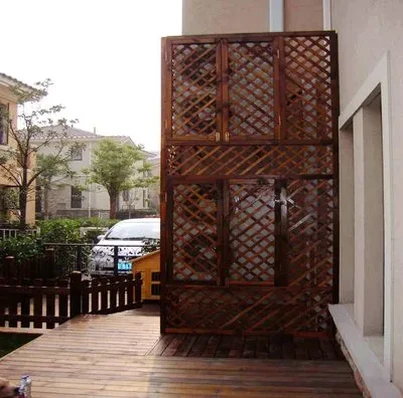
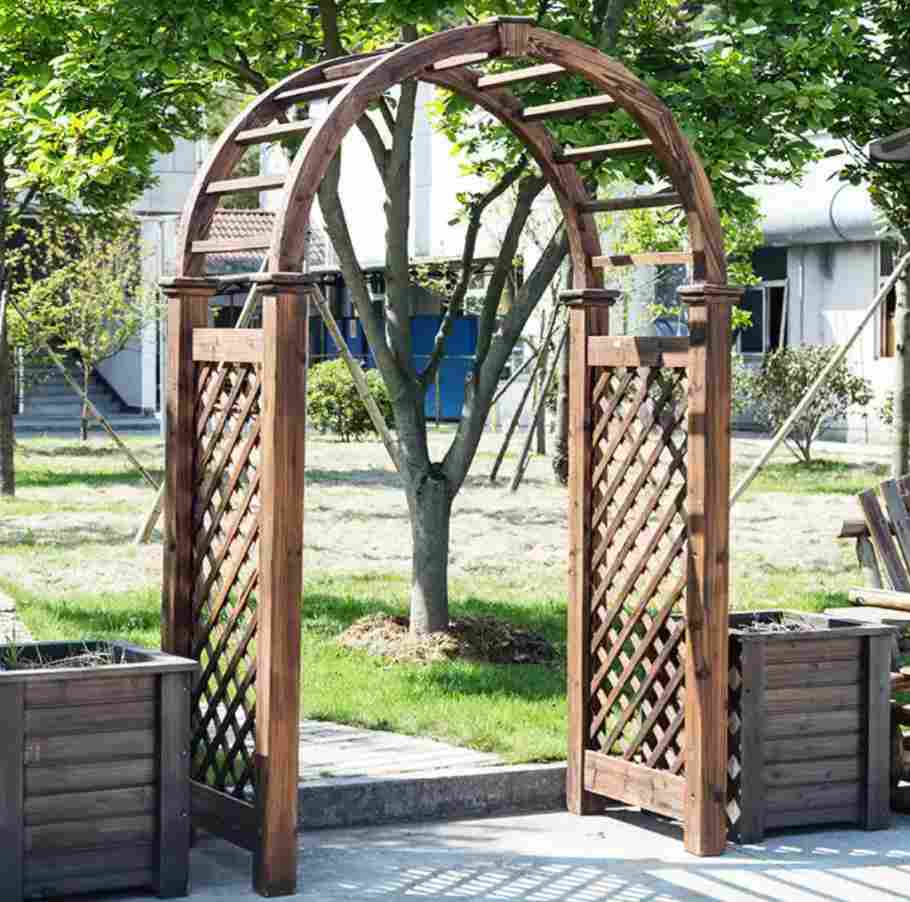
| Heat-treated timber, left breathable | Pergolas, screens, planter boxes in mixed sun | Annual oil, 1 coat | Colour drifts lighter where sun hits hardest; batch-match boards |
| Penetrating oil on hardwood | Pavilion posts, rails, seats handled daily | 18 to 24 months | Needs dry weather for 48 hours after application |
| Stained softwood with a breathable topcoat | Budget-driven structures, painted schemes | 3 to 4 years | Film coats trap moisture at joints if applied too thick |
Heat-treated timber, left breathable
Thermal modification reduces the wood’s equilibrium moisture content and improves dimensional stability, which is why it suits screens and planter boxes that move in and out of irrigation. We keep the surface open: oil, no film. Water that enters can leave again, and the owner can repair a patch instead of sanding a whole panel.
Penetrating oil on hardwood
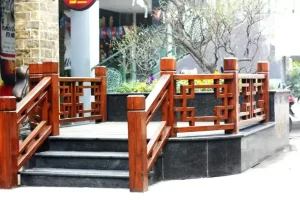
For posts and handrails, a penetrating oil that hardens inside the cell walls is the most forgiving schedule. It does not build a skin, so a scratch stays a scratch rather than a blister. The trade-off is frequency: an exposed seat top in full sun will want oil every 18 months, while the shaded side of the same pavilion can go three years.
Stained softwood with a breathable topcoat
This is the schedule that most often disappoints, not because the materials are poor but because the coating is applied too generously. A thick film on a joint that moves will crack, and once water sits in the crack the timber underneath stays wet. If a project needs a coloured surface, keep the film thin, keep the joints drained, and accept a recoat every three to four years.
How do bay size and eave height change the decision?
They change it in a practical way: they decide how much of the surface a person can reach. A pavilion with a 2.6 m bay and a 2.45 m eave puts the beam soffit within reach of a step stool, so the owner can oil the underside. Push the eave to 2.75 m and the same task needs a ladder, which means it will be deferred. On a structure the family uses every weekend, deferral is how a finish fails.
What did Yuan Ye fix, and what does it leave to the builder?
Yuan Ye (1631), in juan 1, the chapter on site selection, argues that a garden element should be placed according to the ground it stands on, and that a structure can borrow a view rather than own it. That principle still decides finish today: a pavilion that borrows a dark hedge should not be finished in a pale, high-sheen tone, because the contrast will read as a mistake from the house.
The manual does not specify a coating. It fixes the relationship between element and setting, and leaves the surface to the builder. In practice that means a site visit, a colour decision made against the actual backdrop, and a sample board approved in the garden rather than indoors.
How should a homeowner approve a finish before production?
Approve it at full member width, in the garden, in the season the project will be used. A 0.9 m sample board is enough to show grain, sheen and colour at the width of a real rail; a small chip hides all three. Place the board where the pavilion will stand, look at it in the morning and again at dusk, then sign the colour reference.
What does maintenance look like across a year?
| Season | Task | Reason |
|---|---|---|
| Spring | Wash with mild soap, inspect joints, touch up oil on horizontal faces | Winter wetting shows first at seats and rails |
| Early summer | Full oil coat on exposed faces, dry weather only | Longest curing window before heat |
| Autumn | Clear leaf traps, check planter drainage, re-oil high-traffic handrails | Standing water and leaves are the real enemy |
| Winter | Visual inspection only; no coating below 10 C | Oil applied cold will not penetrate |
How is a courtyard pavilion installed without heavy equipment?
It is shipped as numbered members in ISPM-15 crates with an assembly drawing, and erected by a small crew. The sequence matters: set the foundation anchors and check diagonals, assemble the frame on the ground in bays, raise the frame, then fit the roof and finally the surface coats. Finish coats go on after assembly so that no joint is coated before it is closed.
Frequently asked questions
What is the best wood for a private garden pavilion?
For most courtyards we specify a thermally modified or naturally durable hardwood for exposed members, with a penetrating oil finish. It holds dimension through wet and dry cycles and can be repaired locally. Softwood is a reasonable choice where the structure is sheltered and the owner accepts a shorter recoat cycle.
How often does a timber pavilion need re-oiling?
Every 18 to 24 months for horizontal, sun-exposed faces, and every three years for shaded vertical faces. Annual one-coat touch-ups on seats and handrails are cheaper than a full sand-down later, and they keep the surface breathable.
Can the pavilion be assembled by the homeowner?
A two-bay pavilion can be erected by two people with hand tools if the foundation is prepared and the frame is pre-assembled on the ground. We supply numbered members, an assembly drawing and a video walkthrough; for three bays or a raised plinth, a small local crew is faster and safer.
What is the lead time and minimum order?
One pavilion is a valid order; there is no container minimum. Production runs six to eight weeks after drawing approval, plus five to seven weeks of sea freight depending on destination. Finish samples are approved before cutting, so the colour decision does not sit inside the production window.
How is the structure protected in transit?
Members ship disassembled in ISPM-15 heat-treated crates, with hardware in a separate labelled box and the roof sections padded at the ridge. Each crate carries a packing list keyed to the drawing, which is what the receiving site needs to check before signing.
Planning a courtyard pavilion or a garden timber package? Send the bay count, eave height and site photos for a member list and a packed volume. Call/WhatsApp: +86 138 8336 6528. Product reference: traditional Chinese pavilion, custom built. For the route-and-dwell logic behind courtyard layouts, read how a timber pavilion and corridor solve an off-season route problem.