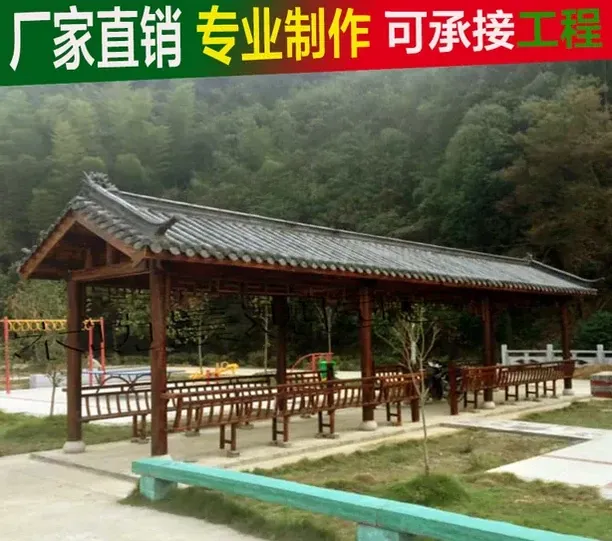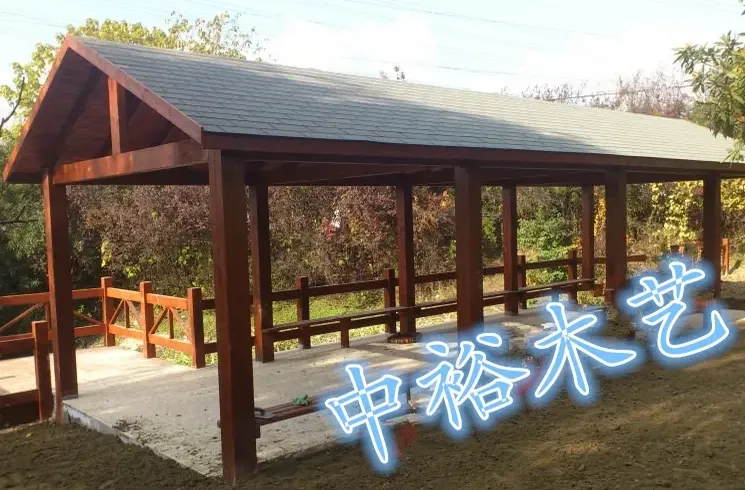
A covered corridor in a public park is replaced twice in fifty years if the timber went into the mill at 18% moisture content, and once if it went in at 12 to 15%. The number looks like a factory detail; it is actually the line between a structure that survives its first winter and one that opens at every joint by year three.
We have installed joinery-framed corridors and pavilions for 48 years across more than 300 projects, and the failures we are called back to repair share one signature: water where the wood meets stone, and a frame that was never allowed to dry before it was cut.
What moisture content actually does
Timber keeps moving after assembly. A 200 mm post machined at 18% and installed at 12% shrinks across the grain by roughly 6 mm in service, and the mortise no longer matches the tenon that was cut to fit it. The joint does not fail dramatically; it opens, takes water, and then the end grain at the column base starts to decay. On corridors we inspect, water intrusion at column bases accounts for about 70% of premature timber decay, which is why the base detail matters more than the species.
Our factory equalises stock to 12 to 15% before assembly. On outdoor park work in a humid climate, that is the practical target: dry enough that the joint stays closed through the first season, not so dry that the member swells and splits when the wet season arrives.
Species is a maintenance decision, not a taste decision
Merbau retains about 85% of its structural density after 25 years of weathering. Untreated pine loses around 40% of its structural capacity in five years. Both statements are true and both are useful: the first sets a 30 to 50 year service life, the second explains why a cheap corridor becomes expensive at year six.
| Specification | Typical build | Our park standard | Effect on service life |
|---|---|---|---|
| Moisture content at machining | 16–20% | 12–15% | Joint stays closed through first winter |
| Joint system | Nailed or screwed frame | Pegged mortise and tenon | 40–50 years vs 10–15 years |
| Column base | Post embedded in soil | Raised base on stone plinth with drainage | Removes the main decay path |
| Species | Untreated pine | Merbau, teak or specified hardwood | Density retained after 25 years |
| Maintenance cycle | Repaint and re-fasten annually | Annual wash and stain, joint inspection | About 60% fewer interventions than a nailed frame |
| Expected lifespan | 10–15 years | 40–50 years | Verified across 48 years of installation records |
The module system that keeps a long corridor straight
A park corridor is usually 30 to 80 m, built in bays. The classical Chinese module system is the reason these long runs stay coherent: Yingzao Fashi (Treatise on Architectural Methods, 1103) grades timber into eight cai modules, and every member of a bracket set and frame is dimensioned as a multiple of that module rather than as an independent number. Lu Ban Jing (the Lu Ban Manual) approaches the same problem from the bay: the width of an opening is set by a rule, and the frame follows the opening.
Practically, this means a corridor can be extended without redrawing: bays repeat, bracket sets repeat, and the joint at bay ten is the joint at bay one. For a municipal client, that also means a repair in year twenty uses the same member size as the original tender, not a custom cut.
Why a nailed frame has a shorter clock
Metal fasteners in a humid park corrode and loosen within 10 to 15 years. Once a screw backs out, the joint has no restraint and the roof line starts to sag between posts. A wood-to-wood joint with a peg has no fastener to corrode; the peg is replaced, the frame is re-tightened, and the member stays.
Public load and public safety
A corridor in a park carries more than its roof. People lean on balustrades, children climb the low rails, and maintenance carts pass underneath. Three checks belong in the drawing: balustrade height and rail spacing to the local code, a roof load case that includes wind uplift at the eave, and a walkway clear width that leaves room for a wheelchair to pass a group.
We review local wind load, rainfall intensity and soil conditions before recommending a bay size, because a 4.2 m clear bay that performs in a courtyard is not automatically the right bay beside an exposed lake.
Installation sequence on an operating park
Most municipal sites cannot close for a month. The sequence that works: set plinths and drainage first, deliver frames in crate-sized subassemblies, raise bays from one end, and keep the public route open behind a hoarded line. A 40 m corridor typically assembles in three to five working days with a four-person crew, once the plinths have cured.
Maintenance that actually extends life
Three tasks per year cover most of it: wash and re-stain before the wet season, clear the base drains, and inspect the joints at the two end bays, which take the most movement. Repainting a nailed frame every year is not maintenance; it is a symptom.
Frequently asked questions
Does a covered corridor need a concrete foundation?
It needs a plinth and a drainage path, not necessarily a raft. On made ground we specify a spreading base under each post so settlement does not pull the frame out of level.
Can a corridor be extended later without redoing the first bays?
Yes, if the first build was set out on a repeating bay module and the joint detail is documented. That documentation is the part most cheap builds omit.
Is hardwood always the right choice?
No. Species selection follows exposure: a shaded courtyard corridor and an exposed lakeside run are different specifications. Merbau and teak suit exposed park work; a protected arcade can use a treated softwood and still reach 25 years.
How long does installation take on a live site?
Typically three to five working days for a 40 m corridor after plinths cure, with the public route maintained behind hoarding.
Next step
Send the corridor length, bay spacing and the exposure of the site. We will return a bay schedule and a base detail, which is the part that decides year ten.
For the engineering breakdown behind these numbers, see our covered corridor lifespan page and the earlier guide on building an ancient pavilion.
Zhongyu Wood Craft, Chongqing, working since 1978. Tel and WeChat: +86 138 8336 6528.