A garden wayfinding system fails at the post, not at the panel. In a living collection, the ground moves, roots lift the paving and irrigation keeps one edge wet all year. A sign that looks correct on a drawing can lean within two seasons if its post is sized for a dry path.
This guide sets out a wayfinding plan for a botanical garden or a public collection: how far apart the decisions should sit, how deep the post should go, how high the panel should read, and how to revise a sign when the collection changes. The reference is a timber sign system, because timber can be repaired and re-lettered without replacing the whole frame.
What makes garden wayfinding different from park signage?
Garden wayfinding is different because the collection changes. A park map can stay valid for a decade; a plant collection loses labels, moves beds and closes paths after storm damage. The sign system must be revisionable at panel level, not rebuilt at post level.
The visitor also arrives with a different question. In a park, the question is often “where is the exit?” In a botanical collection, it is “which route shows me the most without making me walk back?” That question needs a sequence of decisions, not a single map board at the gate.
How far apart should wayfinding decisions sit?
At a comfortable walking speed of 1.2 m per second, a 40 m interval gives the visitor about 33 seconds between decisions. That is enough time to look, choose and move without stopping twice. A 60 m interval gives 50 seconds, which is usually too long when the path forks early.
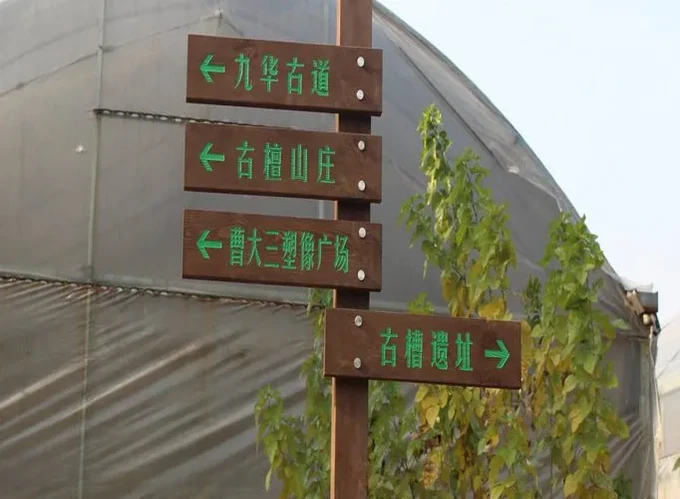
Use 30 to 50 m between direction decisions on a primary loop. Use a shorter interval, 15 to 25 m, at a junction or where a path narrows. Do not count the distance from the gate. Count it from the last point where the visitor could have made a different choice.
The right interval depends on sight lines, planting and visitor pace. Walk the route with a stopwatch before the posts are ordered; a route that reads well on a plan can fail in leaf.
How deep should a sign post go in wet ground?
A 100 x 100 mm timber post should be embedded at least 600 mm in firm, drained ground. In wet ground or beside irrigation, use 800 mm and a concrete collar. The collar should sit above the wet layer, not in it. If the water table reaches the collar, the post will draw moisture and the base will soften.
Do not rely on a surface-mounted plate for a 1.2 m wide map board. A map panel catches wind like a sail. The post needs a moment connection at the base, not just a bolt through the paving. For a two-post map board, set the posts on the same bearing stratum and brace them to each other below the panel.
In root zones, hand-dig rather than machine-dig. A post that cuts a major root will be blamed on the sign, even when the damage happened during installation. Keep the post at least 1.5 times the trunk diameter away from a mature tree, and move the sign rather than the root.
What panel height and finish keep the sign readable?
Set the bottom of the panel at 900 to 1100 mm above the path and the top at 1400 to 1700 mm. That range let a standing adult read without stooping and keeps the panel out of splash. For a low plant label, use a separate stake; do not lower the loop sign to plant height.
A slight upward tilt of 10 to 15 degrees reduces glare from the sky and sheds rain. Do not over-tilt. A 20 degree panel collects leaf litter on the face and reads as a table. Use a matte finish on the panel. A gloss finish turns the sign into a mirror at low sun.
Timber is a good frame material because a damaged panel can be re-lettered or replaced while the posts stay. Specify a stable post section, a removable panel cassette and a joint that can be opened without cutting the post.
What does a four-level sign schedule look like?
A four-level schedule keeps each sign to one job. The table below is a working schedule for a garden loop; adjust the panel size to the reading distance and the type size to the visitor group.
| Level | Job | Panel size | Mounting | Foundation |
|---|---|---|---|---|
| Arrival | Map and route choice | 1200 x 800 mm | Two posts, bottom 900 mm | 800 mm embed plus collar |
| Loop direction | Next decision | 600 x 200 mm | One post, bottom 1000 mm | 600 mm embed, 800 mm in wet |
| Plant identity | Name and collection note | 200 x 150 mm | Stake or low post | 300 mm embed, no collar |
| Safety | Path closure, step, water edge | 300 x 200 mm | One post, bottom 1000 mm | 600 mm embed, reflective face |
The arrival board is the only place where a full map belongs. Repeating the map at every junction wastes panel area and slows the visitor. A direction sign should give one next choice, not the whole garden.
What does Yuan Ye say about siting a garden sign?
Yuan Ye, the garden treatise written by Ji Cheng and published in 1631, begins with site assessment. The chapter Xiang Di puts the site before the building. The lesson for wayfinding is direct: choose the place where the visitor naturally stops, then size the sign for that place.
The old treatise is not a style catalogue. It is a reminder that the site decides the structure. Use it before the post is ordered, not after the concrete is poured.
For the frame and panel options, see the teak scenic wayfinding sign system and the custom wayfinding sign systems for scenic facilities pages. The earlier notes on signage in a living plant collection and timber wayfinding in a public garden cover wet ground and maintenance in more detail.
Installation and maintenance
Install the posts before the panel cassettes arrive. Check plumb in two directions and record the base elevation. A post that is plumb at installation but sits in fill will move. Backfill in 150 mm layers and compact each layer. Do not backfill with wet clay.
Clean the panel face with water and a soft brush; do not use a pressure washer on a lettered surface. Check the post base every six months, especially after a wet season. Re-stain the frame every two to three years. Replace a cracked panel cassette before water reaches the frame joint.
Our standard lead time is 30 to 45 days for a sign package after drawing approval, and longer for a full garden system. The structural warranty is five years. Panels can ship separately from posts, which keeps a revision cheap.
FAQ
How far apart should garden wayfinding signs be?
Use 30 to 50 m between primary direction decisions, and 15 to 25 m at junctions. At 1.2 m per second, 40 m gives the visitor about 33 seconds to read and choose.
How deep should a sign post be in wet soil?
At least 600 mm in firm, drained ground. Use 800 mm plus a concrete collar in wet ground or beside irrigation. Keep the collar above the wet layer.
What height should a garden sign panel be?
Bottom at 900 to 1100 mm and top at 1400 to 1700 mm above the path. A 10 to 15 degree upward tilt reduces glare and sheds rain.
Can we reuse the posts when the collection changes?
Yes, if the panel is a removable cassette. Reuse the post and foundation, replace the panel. A post bolted through the panel face cannot be revised cheaply.
What is the lead time and minimum order?
About 30 to 45 days for a sign package after drawing approval. A single arrival board is possible; a full loop system is priced as a package with a post schedule.
Planning a garden wayfinding system? Call/WhatsApp: +86 138 8336 6528. Zhongyu Woodcraft – 48 Years Traditional Chinese Woodcraft Factory, Nationwide Installation.