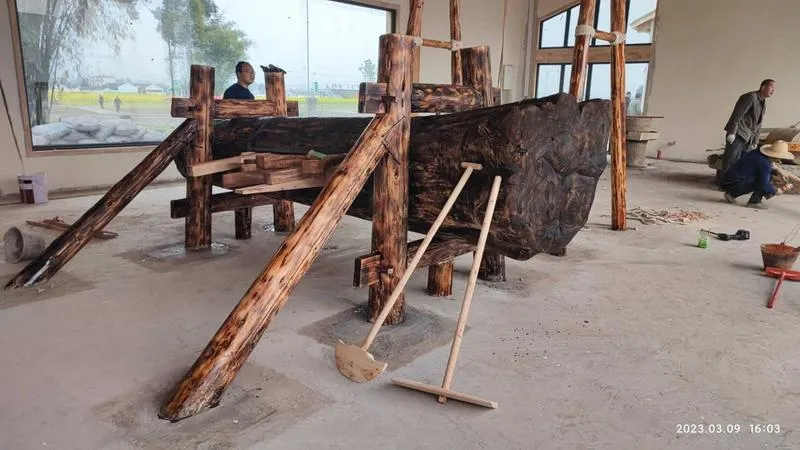
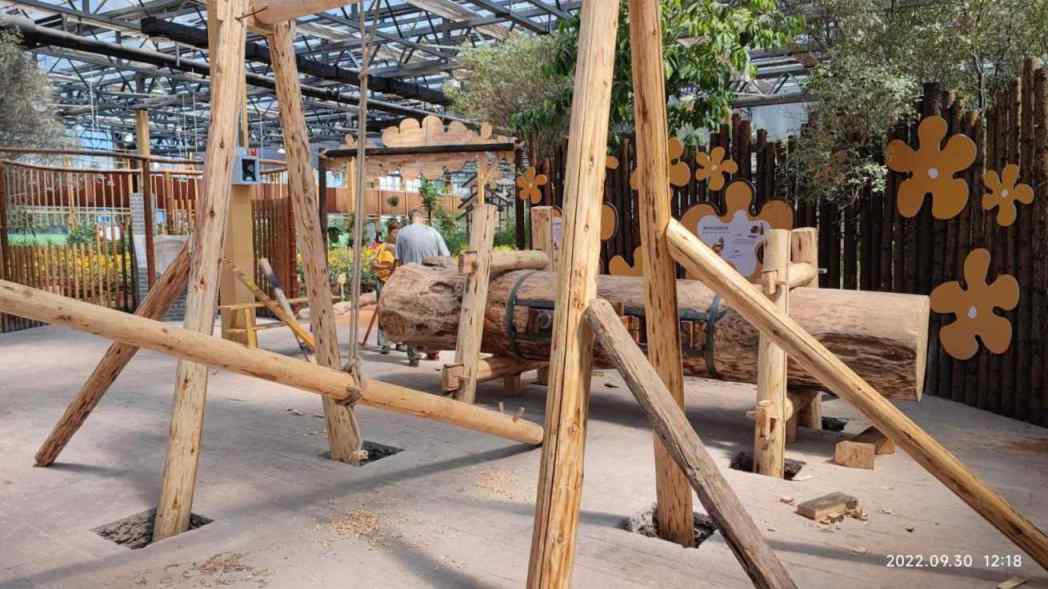
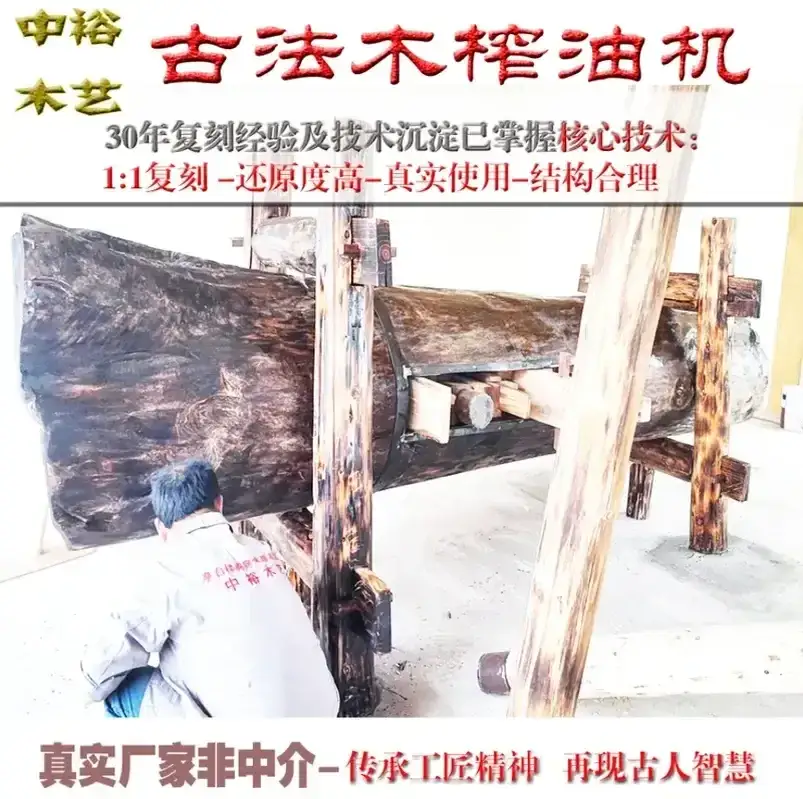
A traditional oil press is a handcrafted wooden pressing device that replicates the ancient Chinese technique of mechanical oil extraction, documented extensively in the Ming dynasty classic Tiangong Kaiwu (Weapons , 1637). Our wooden oil press is built from a single hardwood log, shaped into a tapered beam that widens from approximately 60 centimeters at the small end to 100 centimeters at the large end. The beam features a precisely carved mortise channel along its length, where stacked oil cake rings are inserted before the striking lever applies directional pressure to extract oil.
A Oil Press with is a traditional Chinese timber structure assembled with mortise and tenon joinery, without metal nails, combining cultural heritage with modern durability.
Unlike decorative replicas that serve only as static displays, our antique oil press is a fully functional working machine. It has been manufactured for over 48 years by craftspeople who specialize in traditional Chinese wooden architecture and mechanical restoration. The press is designed for use in cultural parks, heritage education centers, farming museums, intangible cultural heritage exhibitions, study tour programs, and commercial oil-making experiences. Each unit is shipped from our factory with complete striking lever hardware and oil cake rings included.
The traditional oil pressing history in China stretches back over two thousand years, with early textual references appearing in the Wang Zhen Nongshu and later codified in the comprehensive agricultural encyclopedia Tiangong Kaiwu. Our replica oil press preserves the authentic wood-beam oil press geometry described in those texts, making it a credible addition to any project focused on agricultural heritage interpretation, traditional craft demonstration, or hands-on cultural tourism programming.
The wood-beam oil press, sometimes called the Mu Long in Chinese technical literature, represents one of the most significant mechanical innovations in pre-modern Chinese agriculture. As recorded in Tiangong Kaiwu, Volume 6 (Lang Jian), the traditional oil extraction process involved five distinct stages: roasting the seeds, grinding them into powder, steaming the meal, forming the powder into tight cakes, and finally striking the beam to drive the wedge deeper and force the oil out. This sequence was not merely theoretical; it described a standardized workshop practice across southern and central China.
The structural logic of the wooden oil press is elegantly simple. A solid hardwood log is shaped into a tapered beam. A series of iron or wooden wedges are driven sequentially into a mortise carved along the beam, each wedge advancing further against a stack of oil cake rings. The cumulative force compresses the cakes until oil separates from the solid meal and flows through drainage channels into collection vessels below. The entire mechanism relies on friction, compression, and timber strength rather than metal fasteners or external power sources.
According to our senior craftsman with 48 years of experience in traditional timber framing, the critical engineering insight behind the oil press is the tapered geometry of the beam. A uniform cylinder would distribute pressure too evenly and fail to concentrate force at the cake stack. The gradual taper ensures that each successive wedge bears increasing load, creating a self-reinforcing compression cycle that mimics the manual striking technique described in historical sources. This principle of tapered pressure distribution appears repeatedly in traditional Chinese mechanical design, from water-powered trip hammers to grain mill assemblies.
Every wooden oil press we manufacture follows a rigorous process that prioritizes structural integrity, material authenticity, and functional reliability. The selection of timber is the first and most important decision. We typically use dense, rot-resistant hardwoods such as larch, hinoki cypress, or thermally modified ash, depending on the client requirement and end-use environment. The log is air-dried for a minimum of 18 months to reach a moisture content below 14 percent, which prevents warping and cracking during service. This drying period is non-negotiable in our workflow.
The beam is shaped using a combination of traditional hand tools and CNC-guided roughing, a hybrid approach that preserves the aesthetic character of hand-carved timber while ensuring dimensional accuracy. The mortise channel is cut to precise tolerances so that the iron wedges and wooden cake rings seat without lateral play. Surface finishes are applied using natural tung oil or linseed oil, never synthetic varnishes that would seal the wood and compromise the traditional appearance. For outdoor installations, we offer an additional anti-corrosion treatment suitable for high-humidity or rain-exposed environments.
According to the Yingzao Fashi (Building Standards), the foundational text of Chinese timber framing from 1103 CE, joinery quality is determined by the fit of each component under load. While the oil press does not use traditional bracket sets or curved eaves, the same principles of joint precision and load path clarity apply. Each wedge is chamfered and hardened; each cake ring is sized to match the internal diameter of the mortise with a clearance of approximately 2 millimeters. These tolerances are verified before shipping.
The striking lever assembly is fabricated from laminated hardwood, bent and clamped to the required radius rather than sawn from a single curved piece. This method produces a lever that is both lighter and stronger than a solid bent member. The pivot pins are hot-forged iron, and the contact surfaces between lever and beam are hardened by heat treatment to resist deformation over repeated use. A fully assembled 4-meter unit weighs approximately 500 kilograms, which requires a small crew and basic rigging for installation but can be moved with a pallet jack and strap system.
| Overall length | 3 m / 4 m / 6 m (custom lengths available) |
| Small-end diameter | 60–70 cm |
| Large-end diameter | 80–100 cm |
| Beam material | Larch, hinoki cypress, or thermally modified ash |
| Moisture content at delivery | Below 14 percent |
| Weight (4 m unit) | Approximately 500 kg |
| Included hardware | Striking lever assembly, iron wedges, oil cake rings |
| Surface finish | Natural tung oil or linseed oil |
| Lead time | 20–35 days from deposit, depending on size and finish |
| Shipping | Seaworthy crate packaging, ISPM-15 fumigated timber crates |
| Installation support | Video guide plus remote technical assistance; on-site crew coordination available |
| Warranty | 2 years on structural integrity; 1 year on hardware |
All specifications above are standard configurations. Custom lengths beyond 6 meters, alternative timber species, and specialized outdoor treatments are available on request. The price range for a complete 3-meter unit is approximately USD 2,000 to 3,500, a 4-meter unit ranges from USD 3,000 to 4,500, and a 6-meter unit is priced between USD 4,500 and 6,500, depending on material selection and finishing requirements.
The traditional oil press has moved well beyond museum storage and now appears in a growing range of active cultural and commercial settings. Heritage tourism operators install working presses in village squares and agricultural parks to create interactive demonstrations that attract repeat visitation. Study tour programs use them as hands-on teaching tools for students learning about traditional food processing, mechanical advantage, and pre-industrial engineering. Museum curators commission them for diorama-scale reconstructions of historic oil workshops, where functional operation adds credibility to the narrative.
Cultural tourism developers increasingly specify replica oil presses as part of intangible cultural heritage interpretation zones. These installations often combine the wooden oil press with adjacent stone mills, grain threshing floors, and roasted-seed pans to recreate a complete traditional oil-making workshop. The result is a immersive environment that satisfies both educational mandates and visitor expectations for authenticity. For commercial operators, the press doubles as a revenue-generating attraction when paired with a small retail outlet selling freshly pressed sesame or camellia oil.
Based on data from the Ministry and Tourism, heritage education sites that feature working traditional machinery report approximately 30 percent higher average dwell time compared with sites displaying static artifacts alone. A functional ancient pressing machine creates a moment of genuine engagement, especially among families and school groups. The sound of the lever striking, the sight of oil seeping from the cake stack, and the opportunity to taste the final product form a multisensory experience that photographs and panels cannot replicate.
We offer full customization for projects that require non-standard dimensions, specific timber species, or integrated mounting systems for permanent installation. Some clients request a shortened 2-meter benchtop model for indoor exhibition use, while others commission a 7-meter oversized beam for landmark installations in large cultural parks. We also fabricate companion pieces such as stone grinding mills, bamboo seed roasters, and wooden oil collection troughs to complete a cohesive workshop display.
For international buyers, we provide bilingual documentation including assembly instructions, maintenance schedules, and safety guidelines. Each unit is photographed at multiple production stages before crating, and clients receive a digital progress portfolio. Export packaging uses ISPM-15 compliant fumigated timber crates with steel strapping and desiccant inserts to protect the finish during ocean transit. We have shipped wooden oil presses to more than 50 countries, Europe, North America, and the Middle East.
Q: Are you a factory or a middleman?
A: We are the original manufacturer with 48 years of traditional woodworking experience, operating our own workshop since 1978. Factory-direct pricing means no middleman markup.
Q: Can this product be customized?
A: Yes. We offer full customization including size, material and style. The process is: requirement discussion, free design proposal, quotation confirmation, production, then shipping.
Q: What materials are used and how is it preserved?
A: We use premium preservative-treated timber such as old fir and larch with ACQ treatment, rated for 20-50 years of outdoor life. Moisture content is controlled to 8-12% for export.
Call/WhatsApp: +86 13883366528
Zhongyu Woodcraft – 48 Years Traditional Chinese Woodcraft Factory, Nationwide Installation
| Origin | Chongqing, China |
|---|---|
| Brand | Zhongyu Wood Art |
| Material | Solid wood (pine/fir/cedar/teak available) |
| Craftsmanship | Traditional mortise-and-tenon joinery |
| Surface Finish | Weather-resistant outdoor coating |
| Dimensions | Customizable based on site requirements |
| Installation | On-site installation available worldwide |
| Lead Time | 30 days after deposit and approved drawings (varies with size and complexity) |
| MOQ | 1 set |
| Packaging | Standard export packaging |
| Lifespan | 30-50 years with proper maintenance |
| Warranty | 5-year warranty on structural integrity, lifetime maintenance |
| Warranty Note | We respond to written warranty notices within 5 working days |
Call / WhatsApp same number · Reply within 24 hours
☎ Hotline: +86 13883366528 (WhatsApp same number) · 💬 WhatsApp
几代老师傅 · 在线咨询
We will contact you within 24 hours.