Most touring oil presses are judged by how old they look. The failure usually starts earlier, in a packing list that treats a 180 kg pressure beam like a prop. A beam that cannot be lifted without a forklift, a frame with no sequence marks, and trays that are not food-safe will turn a three-day install into a week of guesswork.
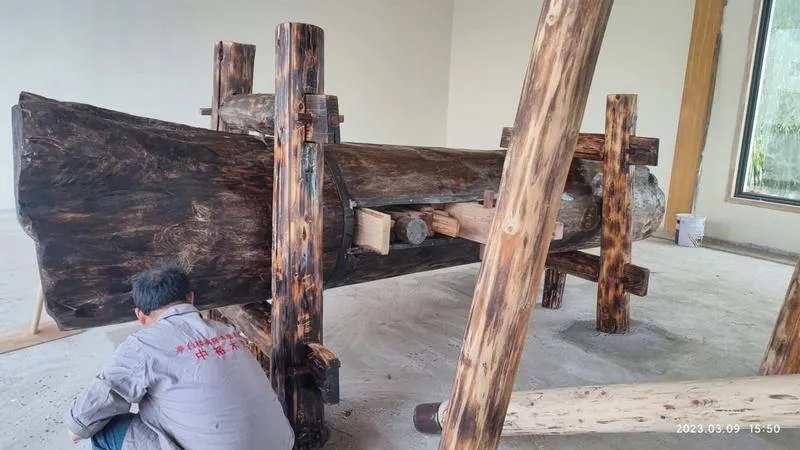
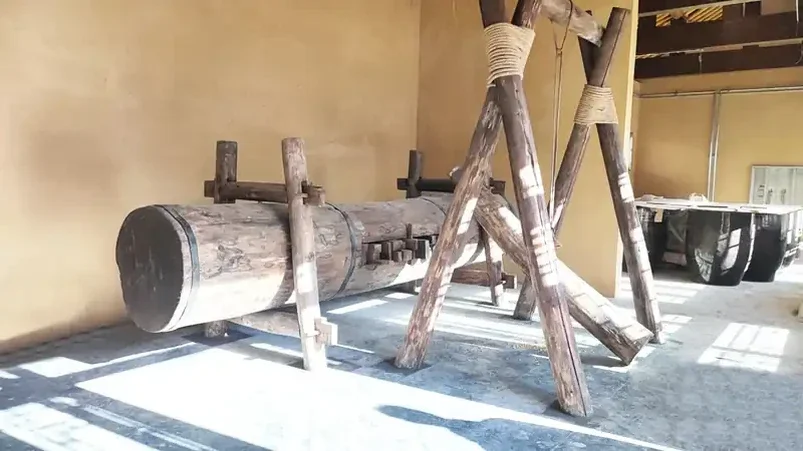
This article is written from the registrar’s side of the table: what to measure, what to mark, and what to reject before the crate leaves the museum. The reference object is a traditional Chinese wedge press, not a decorative copy. Its logic is simple. A heavy beam applies pressure through wedges. The frame carries the load. The trays catch the oil. Every part needs a handling plan.
The load path is the first specification
On our standard oil press, the main pressure beam is 300 cm x 20 cm x 20 cm and weighs about 180 kg. The two vertical posts are 220 cm x 15 cm x 15 cm, 45 kg each. The sliding frame is 180 cm x 12 cm x 12 cm at 30 kg. Each oil tray is 40 cm x 40 cm x 10 cm and 5 kg.
These numbers matter because they set the minimum crate length and the number of people on the lift. A 300 cm beam needs about 320 cm of internal crate length once padding and blocking are included. Do not order a crate from the beam’s nominal length alone. The beam also needs four blocking points so it cannot roll against the crate wall.
What Tiangong Kaiwu says about oil
Tiangong Kaiwu, chapter 12, Gao Ye (Fats and Oils), opens with a useful idea. Oil is locked inside the seed and will not flow by itself. It needs water, fire, wood and stone to release it. That is a process statement, not a poem.
Heat prepares the seed. The wedge press supplies pressure. The wooden receiver holds the liquid. A museum display that shows only the press misses two-thirds of the process. A better exhibit pairs the press with a small seed sample, a heating pan and a clear tray, so visitors can see where the oil comes from. The display does not need to run oil every day. It needs to show the sequence.
Specification table for a touring set
| Component | Standard size | Mass | Handling note | Interpretive role |
|---|---|---|---|---|
| Main pressure beam | 300 x 20 x 20 cm | 180 kg | Four-point block; 320 cm crate | Shows where pressure is applied |
| Vertical posts | 220 x 15 x 15 cm | 45 kg each | Two-person lift; protect tenons | Carries the beam load |
| Sliding frame | 180 x 12 x 12 cm | 30 kg | Bundle with wedges in Crate 3 | Guides the press block |
| Oil trays | 40 x 40 x 10 cm | 5 kg each | Food-safe cover; stack separately | Shows the liquid path |
| Wedges and pegs | Project-specific | Small parts | 10 percent spares; labelled bag | Explains dry assembly |
The table is a handling schedule as much as a size chart. A light part with a sharp tenon can do more damage in transit than a heavy beam on a pallet.
Crate sequence that survives a loading dock
Number crates by install step, not by component type. Crate 1 holds posts and wedges. Crate 2 holds the beam, blocked at four points. Crate 3 holds the sliding frame, trays and small parts. Put a laminated sequence card in Crate 1, not in a document folder that travels separately.
Mark each timber with a removable label on a hidden face. Do not stamp the show face. If the museum will tour the set more than once, use a small brass tag in a recess and record the tag number in the condition report.
Include a lifting plan. The beam is the only piece that should need a pallet jack or a two-person lift. If the museum’s freight elevator is shorter than 320 cm, plan a vertical beam crate or a site assembly from two halves. Decide that before production, not at delivery.
Dry rebuild and food-contact questions
Traditional presses are dry-fitted. The frame should lock with mortise-and-tenon joints and wedges, not with nails through the show face. For a touring set, the dry fit is an advantage. It can be taken apart and rebuilt without a conservator. It is also a risk. Small wedges disappear in transit. Pack 10 percent spares and label them.
The oil trays are the food-contact surface. Specify food-grade wood and a finish appropriate for the display mode. If the museum will not press oil, keep the trays dry and use seeds in a closed sample jar. Do not run unknown oil through a display press. Residue attracts dust, and every future cleaning becomes a conservation treatment.
For the full component schedule and finish options, see the antique oil press product page. If you are planning a paid demonstration, the earlier note on a working oil press as a paid experience covers ticketing, supervision and cleaning.
Installation and maintenance
Install on a level floor with a moisture barrier. Keep the room between 45 and 60 percent relative humidity. Dust with a dry brush; do not wet the beam. Check wedge tightness monthly and re-mark any part that moves. Keep a 1 m barrier around the press footprint so visitors cannot lean on the wedges.
Our standard lead time is 45 to 60 days. Structural warranty is 5 years, with worldwide on-site installation available. A set can be shipped disassembled, which is the normal mode for a touring exhibition.
FAQ
How heavy is a touring oil press?
The standard set is dominated by the 180 kg beam, two 45 kg posts, a 30 kg frame and four 5 kg trays. The crate and blocking add weight, so confirm the total with the freight forwarder.
Can the press actually make oil?
Yes. For a museum, many sets run dry and use seed samples to explain the process. If you press oil, specify food-grade trays, a cleaning schedule and supervised operation.
What is the lead time?
About 45 to 60 days for a custom set, depending on drawings and finish. The structural warranty is 5 years.
How many crates does a set need?
Typically three. The beam crate is the longest and must allow about 320 cm inside. Confirm the elevator and door clearance before packing.
Can our team install it without a factory crew?
Yes, with the assembly drawings and a two-person lift for the beam. On-site installation is available worldwide if you prefer a factory crew.
Planning a touring timber exhibit? Call/WhatsApp: +86 138 8336 6528. Zhongyu Woodcraft – 48 Years Traditional Chinese Woodcraft Factory, Nationwide Installation.