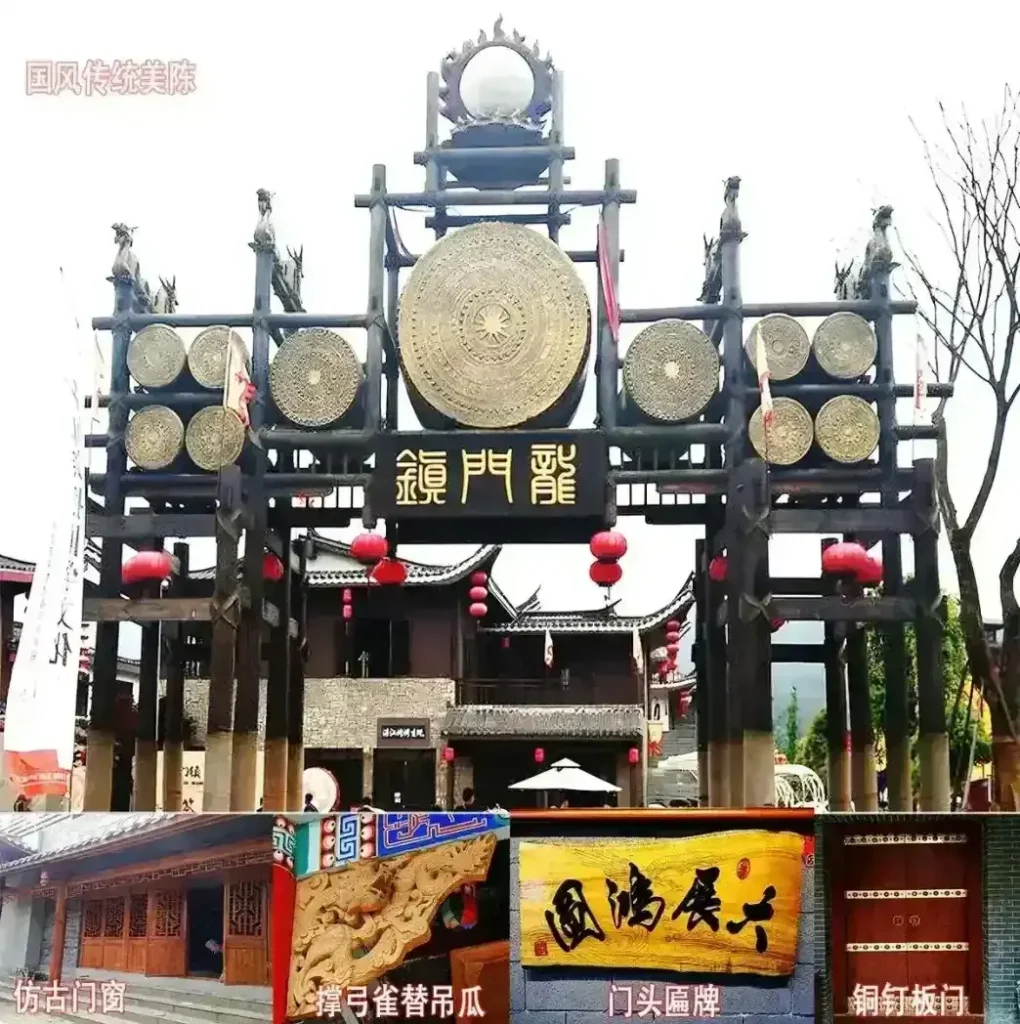
An antique-style gateway is the first architectural handshake between a visitor and a heritage destination. In cultural tourism across these timber portals do far more than mark an entrance; they compress centuries of local identity into a single wooden frame. For international travelers, designers, and developers, understanding how these structures are conceived, cut, and assembled reveals a living craft tradition that has survived dynasties and now anchors rural revitalization projects. This guide unpacks the anatomy of the traditional gateway, the role of mortise and tenon joinery, and how modern scenic areas commission authentic structures without losing historical integrity.
In 2026, cultural tourism accounts for over 60 percent of domestic travel in China, with ancient towns and heritage villages as primary magnets. A gateway is usually the first and most photographed element. Yet many developers face a perplexing problem: off-the-shelf metal or fiberglass replicas fail to deliver the emotional weight of aged timber. The solution lies not in imitation but in authentic reproduction using time-tested joinery. This article explains what makes a gateway genuinely traditional, why wood species and joinery matter, and how a 48-year-old workshop in China supplies these structures to scenic areas nationwide.
Historical Origins: The Gateway as Social Threshold
The Chinese gateway, or menlou, evolved from simple defensive gates in the Zhou Dynasty (1046–256 BCE) into elaborate status markers by the Ming and Qing periods. Unlike the Japanese torii, which marks a sacred boundary, the Chinese gateway historically separated administrative or residential zones. The paifang, a related form, was erected to honor filial piety, chastity, or imperial merit. Both share structural DNA: vertical posts, horizontal beams, and layered eaves that signal hierarchy.
Song Dynasty builder Li Jie, in his 1103 CE treatise Yingzao Fashi, codified modular proportions for these structures. His system ensured that a beam’s depth related to the bracket set above it, creating visual harmony independent of absolute scale. This modular logic persists in modern workshops. When Zhongyu Woodcraft receives an order for a 6-meter-wide gateway, craftsmen first calculate the cai-fen modulethe fundamental unitbefore selecting timber. This is not nostalgia; it is structural mathematics validated over nine centuries.
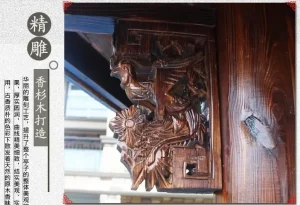
Regional variations complicate the picture. Northern gateways favor robust, unadorned posts suitable for cold climates, while southern examples in Jiangnan water towns incorporate carved que ti brackets under beams. A gateway in a Shanxi courtyard differs from one in a Sichuan mountain village. For cultural tourism projects, matching regional style is as critical as matching joinery. A generic ‘Chinese gateway’ often fails local authenticity tests. Developers should specify the dynasty or regional style they wish to evoke, just as a European client would choose between Tudor and Gothic revival.
Craftsmanship: Mortise and Tenon Without a Single Nail
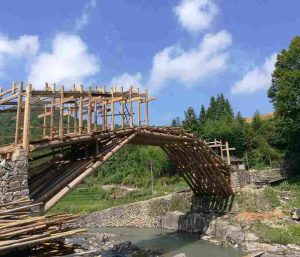
The defining feature of a traditional gateway is its joinery. Mortise and tenon construction, known in Chinese as sunmao, requires no nails, screws, or adhesives. A projecting tenon on one beam fits precisely into a recessed mortise on another, creating a joint that grows tighter under structural load. This is not a primitive technique; it is a sophisticated system of interlocking timber that has been refined over millennia.
Zhongyu Woodcraft employs three primary joint types in gateway construction. The chuandou system, common in southern China, uses through-tenons that pierce vertical posts and are secured with wooden pegs. The tailiang system, favored in the north, stacks horizontal beams on posts with bracket sets. The dougong bracket set, the most complex, consists of interlocking wooden blocks and arms that distribute roof weight and create the characteristic overhanging eaves. A single gateway may combine all three systems, requiring craftsmen who understand each tradition.
The precision required is extraordinary. A tenon must fit its mortise with a tolerance of less than one millimeter. Too loose and the joint wobbles; too tight and the wood splits during assembly. Zhongyu craftsmen use traditional marking tools, including the doujiao angle square and mozhui ink marker, to lay out joints before cutting. Each piece is numbered and test-fitted on the workshop floor before disassembly and shipping. This ensures that on-site assembly requires only basic tools and no on-site cutting.
Material Selection: Why Wood Species Matter
A gateway is only as good as its timber. Zhongyu Woodcraft selects wood based on three criteria: structural strength, decay resistance, and regional authenticity. For primary structural posts, the company favors shanmu (Chinese fir), which is naturally resistant to rot and insects, and songmu (pine), which offers excellent strength-to-weight ratio. For decorative elements and carved brackets, taoshanmu (fir) and zhangmu (camphor) are preferred for their fine grain and workability.
Wood selection is not merely aesthetic. A gateway in a humid southern climate requires different timber than one in a dry northern climate. Chinese fir, for example, contains natural oils that repel termites and resist fungal decay, making it ideal for humid regions. Pine, while stronger, requires more maintenance in wet environments. Zhongyu craftsmen assess the project location and recommend species accordingly, ensuring that the gateway will withstand decades of exposure.
All timber undergoes a rigorous conditioning process. Freshly cut wood is air-dried for six to twelve months, then kiln-dried to a moisture content of 12-15 percent. This prevents warping, cracking, and shrinkage after installation. The wood is then treated with a natural preservative derived from tung oil and lime, a traditional formula that protects against moisture without compromising the wood’s natural appearance. For projects requiring enhanced durability, Zhongyu offers carbonized wood treatment, which heat-treats the surface to create a rich, aged patina while improving decay resistance.
Customization Process: From Concept to Installation
Commissioning a traditional gateway is a collaborative process. Zhongyu Woodcraft follows a five-step workflow that ensures every project meets the client’s vision while maintaining historical authenticity. The process begins with a consultation, during which the client specifies the gateway’s purpose, location, dimensions, and desired historical style. Zhongyu designers then research regional architectural traditions and produce preliminary sketches, often referencing historical examples from the Song, Ming, or Qing dynasties.
Once the design is approved, Zhongyu craftsmen create detailed shop drawings using both traditional drafting techniques and modern CAD software. These drawings specify every timber dimension, joint type, and decorative element. The client reviews and approves the drawings before production begins. The fabrication phase typically takes four to eight weeks, depending on the gateway’s size and complexity. During this phase, the client receives regular progress updates and photos from the workshop.
After fabrication and test-fitting, the gateway is carefully disassembled, labeled, and packed for shipping. Zhongyu uses custom crating to protect delicate carved elements during transit. On-site installation is led by a master craftsman who oversees a team of two to four workers. Installation typically takes three to seven days, depending on the gateway’s size. The team uses only traditional tools and techniques, ensuring that the assembled gateway is structurally sound and historically accurate. After installation, the client receives a maintenance guide and a one-year warranty covering structural integrity.
Case Study: Reviving a Ming Dynasty Gateway in Jiangnan
In 2025, Zhongyu Woodcraft completed a notable project for a cultural tourism development in the Jiangnan water town region. The client, a heritage preservation company, requested a replica of a Ming Dynasty gateway that had stood at the entrance of a historic canal district until its demolition in the 1960s. The project required meticulous historical research, as only two black-and-white photographs and a brief written description survived.
Zhongyu’s research team studied the photographs, analyzed similar surviving gateways in the region, and consulted architectural historians specializing in Ming Dynasty timber construction. They determined that the original gateway featured a chuandou structural system with dougong bracket sets, carved que ti brackets under the beams, and a two-tiered roof with curved eaves. The gateway was 5.8 meters wide and 6.2 meters tall, with three bays.
Fabrication took seven weeks. The craftsmen used Chinese fir for the primary posts and beams, camphor wood for the carved decorative elements, and pine for the roof rafters. Every joint was cut to traditional specifications and test-fitted in the workshop. The finished gateway was shipped to the site and assembled in five days. The client reported that the gateway exceeded expectations, with local historians noting its remarkable accuracy to the original. The gateway now serves as the centerpiece of the restored canal district, welcoming visitors and anchoring the area’s cultural identity.
Frequently Asked Questions
How long does a traditional wooden gateway last?
With proper maintenance, a traditionally constructed wooden gateway can last 80-120 years or more. Historical examples in China have survived for centuries, though they typically require periodic restoration. Key factors affecting longevity include wood species, joinery quality, exposure to the elements, and regular maintenance. Zhongyu gateways come with a one-year structural warranty and a detailed maintenance guide to help clients maximize their investment’s lifespan.
Can you replicate a specific historical gateway?
Yes. Zhongyu Woodcraft specializes in historical replication. Our research team studies surviving examples, historical photographs, architectural records, and regional building traditions to create accurate replicas. We can replicate gateways from specific dynasties (Song, Ming, Qing) or regional styles (Jiangnan, northern, Sichuan, etc.). The more documentation available, the more accurate the replication. For projects with limited documentation, we work with architectural historians to develop historically informed designs.
What is the typical cost range for a custom gateway?
Costs vary based on size, complexity, wood species, and decorative elements. A simple single-bay gateway starts at approximately $3,000-5,000. A medium-sized three-bay gateway with carved details typically ranges from $8,000-15,000. Large, complex gateways with multiple tiers, extensive carving, and rare wood species can cost $20,000 or more. Zhongyu provides detailed quotations after the initial consultation, with no obligation. We also offer phased payment options for larger projects.
Do you provide international shipping and installation?
Yes. Zhongyu Woodcraft ships worldwide and provides international installation services. We have completed projects in North America, Europe, Southeast Asia, and Australia. For international clients, we handle all shipping logistics, including custom crating, export documentation, and freight coordination. Our installation teams travel internationally and typically require 5-10 days on-site, depending on the project size. We recommend that international clients budget for travel and accommodation costs for the installation team, which we can include in the quotation.
How do you ensure the gateway is structurally safe?
Structural safety is our top priority. Every gateway is engineered to meet or exceed modern building codes while maintaining traditional aesthetics. Our structural calculations account for wind loads, snow loads, seismic activity, and the specific site conditions. We use only properly seasoned timber with verified moisture content. Every joint is test-fitted in our workshop before shipping. On-site installation is supervised by a master craftsman with 20+ years of experience. We also provide structural engineering certification for projects requiring building permit approval.
Frequently Asked Questions
Q: What is the lead time for custom orders?
A: Standard products take 7-15 days, complex custom orders 15-30 days, and large projects 30-60 days. Zhongyu Woodcraft provides accurate timeline estimates after confirming your requirements and strictly adheres to delivery schedules.
Q: What materials do you use?
A: We guarantee 100% solid wood with a fake-one-compensate-ten policy. Common materials include Scotch pine, Douglas fir, Merbau, and Nanmu. All wood undergoes traditional carbonization and anti-corrosion treatment, ensuring 30+ years of durability.
Q: Do you offer installation services?
A: Yes, we provide nationwide on-site installation services across China. Our professional installation team covers all 31 provinces. Installation fees depend on project scale and location, with large projects eligible for free installation.
Call/WhatsApp: +86 13883366528
Zhongyu Woodcraft – 48 Years Traditional Chinese Woodcraft Factory, Nationwide Installation