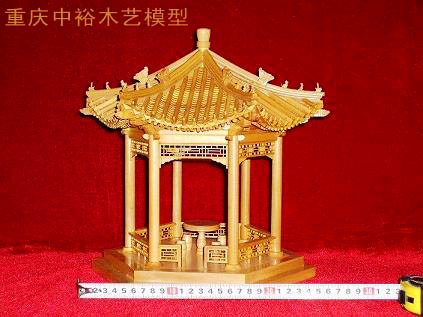

A Chinese classical garden pavilion (ting, ) is an open-sided wooden structure with a curved, upturned roof, designed as a focal point and resting place in traditional Chinese gardens. With roots stretching back over 2,000 years to the Han Dynasty, the pavilion evolved from a simple watchtower into one of the most iconic elements of Chinese landscape architecture. At Zhongyu Woodcraft, we build authentic classical garden pavilions using traditional mortise and tenon joinery, serving clients in over 30 countries with custom design, manufacturing, and worldwide installation services.
The Chinese pavilion, known as ting (), is perhaps the most recognizable element of traditional Chinese garden design. Unlike Western pavilions, which are often enclosed structures, Chinese pavilions are typically open on all sides, with a roof supported by columns and no walls. This open design allows visitors to enjoy 360-degree views of the surrounding garden while providing shelter from sun and rain.
The character ting () itself is pictographic, depicting a roof above a platform with columns. Pavilions have been a feature of Chinese gardens since at least the Han Dynasty (206 BC –
220 AD), when they were used as watchtowers and rest stops along roads and waterways. By the Tang Dynasty (618-907 AD), pavilions had become essential elements of imperial and scholar gardens, and by the Song Dynasty (960-1279 AD), the classical pavilion design had been refined to its peak, with detailed treatises on construction written by architects such as Li Jie in his Yingzao Fashi (State Building Standards, 1103 AD).
Classical Chinese pavilions are classified by several characteristics: the number of sides (hexagonal, octagonal, square, round), the number of roof tiers (single, double, triple), the roof style (curved, flat, pyramidal), and the decorative elements (carvings, paintings, calligraphy). Each type has specific symbolic meanings and appropriate uses within a garden composition.
| Feature | Specification | Options |
|---|---|---|
| Shape | Hexagonal (most common), octagonal, square, round, fan-shaped | Custom shapes available |
| Size (diameter) | 2m – 12m (custom sizes available) | Small (2-4m), Medium (4-7m), Large (7-12m) |
| Height (floor to roof peak) | 3m – 10m (proportional to diameter) | Custom proportions available |
| Roof Tiers | Single tier (standard), double tier, triple tier | Custom tier configurations |
| Roof Style | Curved upturned (classical), pyramidal, flat, thatched | Custom roof designs |
| Roof Material | Traditional gray tiles, glazed tiles (various colors), thatch, wood shingles | Custom materials available |
| Column Material | Chinese fir, camphor wood, pine, merbau, nanmu | Custom wood species |
| Joinery | Traditional mortise and tenon (dougong brackets), no nails or screws | Hidden metal reinforcements available |
| Floor | Elevated wooden platform, stone base, or ground-level | Custom flooring options |
| Decorative Elements | Carved brackets, painted beams, calligraphy plaques, lattice windows | Custom decoration packages |
| Finish | Natural wood, traditional lacquer, custom paint colors | Food-safe and eco-friendly options |
| Installation | On-site installation worldwide, or self-assembly with instructions | Professional installation recommended |
Every pavilion we build is designed by our master architects, who study classical Chinese architectural texts and existing historical pavilions to ensure authentic proportions and details. The famous Yingzao Fashi (1103 AD) and Gongbu Gongcheng Zuofa Zeli (1734 AD) provide the foundational proportions and construction methods, which we adapt to modern building codes and site conditions while maintaining historical authenticity.
| Wood Species | Density | Outdoor Lifespan | Price Level | Best For |
|---|---|---|---|---|
| Chinese Fir (Cunninghamia lanceolata) | 0.45 g/cm³ | 15-20 years | Budget-friendly | General garden pavilions, dry climates |
| Camphor Wood (Cinnamomum camphora) | 0.55 g/cm³ | 20-25 years | Mid-range | Insect-prone areas, aromatic preference, detailed carving |
| Pressure-Treated Pine | 0.50 g/cm³ | 20-30 years | Mid-range | Wet climates, high humidity, coastal areas |
| Southern Yellow Pine | 0.59 g/cm³ | 20-25 years | Mid-range | Structural components, heavy loads |
| Nanmu (Phoebe zhennan) | 0.55 g/cm³ | 30-40 years | Premium | High-end classical pavilions, imperial style, museum quality |
| Merbau (Intsia bijuga) | 0.85 g/cm³ | 30-50 years | Premium | Coastal areas, tropical climates, permanent installations |
| Old Elm (Ulmus pumila) | 0.65 g/cm³ | 20-30 years | Mid-high | Rustic style, aged appearance, decorative elements |
Chinese fir is the most traditional and commonly used wood for garden pavilions, prized for its light weight, workability, and natural resistance to decay. The wood’s pale yellow color and straight grain create a clean, elegant appearance that weathers beautifully to a silver-gray patina over time. For pavilions with extensive carved details, camphor wood is preferred because its fine, even grain allows for intricate carving without splitting or chipping.
For premium and museum-quality pavilions, nanmu (Phoebe zhennan) is the most prestigious wood, historically reserved for imperial buildings and high-status scholar residences. Nanmu’s golden-brown color, subtle fragrance, and exceptional durability make it the ultimate choice for classical Chinese architecture. For coastal and tropical environments, merbau offers exceptional resistance to salt air, humidity, and insect damage, with a rich reddish-brown color that deepens with age.
| Pavilion Type | Characteristics | Garden Position | Symbolic Meaning |
|---|---|---|---|
| Hexagonal Pavilion (Liujiao Ting) | Six sides, six columns, most common classical type | Center of garden, on hilltop, by water | Harmony, balance, six directions of space |
| Octagonal Pavilion (Bajiao Ting) | Eight sides, eight columns, larger and more grand | Main focal point, entrance plaza, large gardens | Prosperity, eight trigrams (bagua), completeness |
| Square Pavilion (Sijiao Ting) | Four sides, four columns, simplest form | Courtyard corner, path junction, small gardens | Stability, earth, four seasons, four directions |
| Round Pavilion (Yuan Ting) | Circular plan, no corners, smooth flowing form | By water, in moon gate courtyard, meditation garden | Heaven, unity, perfection, cycle of life |
| Fan-shaped Pavilion (Shanmian Ting) | Fan shape, one curved side, one straight side | Against wall, at end of corridor, garden boundary | Openness, welcoming, spreading knowledge |
| Double-tier Pavilion (Chongyan Ting) | Two roof tiers, taller and more imposing | Important focal point, temple grounds, large parks | Status, dignity, connection between earth and heaven |
| Water Pavilion (Shui Ting) | Built over water, on pillars or platform | Over pond, by lake, on stream | Reflection, tranquility, water element |
| Mountain Pavilion (Shan Ting) | Built on hilltop or elevated platform | Hilltop, rockery top, highest point in garden | Overview, aspiration, rising above |
In classical Chinese garden design, the placement of a pavilion is as important as its design. Pavilions are strategically positioned to frame views, create focal points, and provide resting places along garden paths. The famous garden design manual Yuanye (The Craft of Gardens, 1631 AD) by Ji Cheng devotes an entire chapter to pavilion placement, emphasizing that a pavilion should “borrow”
views from the surrounding landscape and become part of the larger composition rather than standing alone.
Our design team can work with you to determine the optimal pavilion type, size, and placement for your specific garden or site. We consider factors such as sight lines, circulation patterns, sun exposure, wind direction, and existing landscape features to create a pavilion that enhances your space and follows classical Chinese garden design principles.
| Factor | Zhongyu Woodcraft | Typical Construction Company | Mass Producer |
|---|---|---|---|
| Historical Authenticity | Researched from classical texts, master architects | Approximate, may not follow classical proportions | Standardized, not historically accurate |
| Master Craftsmen | 30+ with 20+ years, some from architectural families | General carpenters, no classical training | Factory workers, no traditional skills |
| Joinery | Traditional mortise and tenon, dougong brackets, no nails | Mixed joinery, may use nails and screws | Nails, screws, glue, no traditional joinery |
| Custom Design | Full custom design from classical architects | Limited customization, standard plans | Standard sizes and designs only |
| Wood Selection | Hand-selected, kiln-dried, 6-month seasoning | Whatever is available, may be green | Cheapest available, often poor quality |
| Roof Tiles | Traditional handmade gray or glazed tiles | Modern concrete or composite tiles | Cheap mass-produced tiles |
| Installation | Worldwide on-site by our master craftsmen | Local only, may not know classical methods | Self-assembly with instructions |
| Project Management | Dedicated project manager from design to completion | Variable, depends on company size | None, you manage everything |
| Warranty | 10-year structural warranty, lifetime joinery guarantee | 1-2 years typical | 90 days to 1 year |
Our workshop in China covers 8,000 square meters with dedicated areas for timber processing, joinery, carving, painting, and assembly. We maintain an inventory of over 500 cubic meters of kiln-dried timber in various species, allowing us to start production immediately upon order confirmation. Each pavilion is fully assembled in our workshop before shipping, allowing us to verify that all joints fit correctly, the structure is stable, and the proportions are correct. We then disassemble the pavilion, number each component, and package it for shipping with detailed assembly instructions.
For international clients, we offer worldwide installation services. Our master craftsmen can travel to your location to assemble the pavilion on-site, typically taking 1-2 weeks for a medium-size pavilion. We handle all travel arrangements, visas, and equipment shipping, and our team speaks English for clear communication throughout the installation process. For clients who prefer self-assembly, we provide detailed numbered instructions, assembly videos, and remote technical support via video call.
Q: How much does a traditional Chinese garden pavilion cost?
A: Prices range from $3,000 for a small 2m simple square pavilion to $50,000+ for a large 10m double-tier octagonal pavilion with premium wood and extensive carvings. The final cost depends on size, shape, wood species, roof material, decorative elements, and installation requirements. As a rough guide, medium-size pavilions (4-7m diameter) in Chinese fir with traditional gray tiles typically cost $8,000-$20,000 including manufacturing and packaging. Contact us with your specifications for a detailed quotation within 48 hours.
Q: How long does it take to build and deliver a pavilion?
A: Standard pavilions typically take 30-45 days to manufacture, plus 25-45 days for international sea freight (or 5-10 days for air freight). Custom-designed pavilions with extensive carvings or premium materials may take 60-90 days. On-site installation by our team typically takes 1-2 weeks for a medium-size pavilion. We provide detailed project timelines with milestones at the time of order, and our project manager keeps you updated throughout the process.
Q: Can a pavilion be installed in a location with extreme weather (high winds, heavy snow, earthquakes)?
A: Yes, we can engineer pavilions to withstand extreme weather conditions. For high-wind areas, we add hidden steel reinforcements to the structure and ensure proper anchoring to the foundation. For heavy-snow areas, we increase the roof pitch and strengthen the roof structure to handle snow loads. For earthquake-prone areas, our traditional mortise and tenon joinery actually provides excellent seismic resistance because the flexible joints allow the structure to move and absorb energy rather than cracking. We can provide structural engineering calculations and certifications for specific building code requirements in your location.
Q: What maintenance does a wooden pavilion require?
A: Traditional wooden pavilions are surprisingly low-maintenance. Monthly visual inspections take about 15 minutes. Quarterly cleaning to remove leaves, debris, and algae takes 30-60 minutes. Annual inspection of joints, roof tiles, and wood finish takes 1-2 hours. Every 2-3 years, reapply wood preservative or finish (1-2 days). Every 5-10 years, inspect roof tiles and replace any that are cracked or missing. With proper maintenance, a well-built pavilion can last 50-100 years or more. We provide a comprehensive maintenance guide with every pavilion, and we offer maintenance services for clients who prefer professional care.
Q: Do you provide the foundation and base for the pavilion?
A: We provide detailed foundation plans and specifications tailored to your specific pavilion size and site conditions. The foundation is typically a concrete slab or stone base that you or a local contractor prepares before our installation team arrives. We can also provide stone bases, wooden platforms, or elevated decking as part of your pavilion order. For water pavilions built over ponds or lakes, we provide detailed engineering plans for the supporting pillars and underwater foundation. Our project manager will work with you to ensure your foundation is prepared correctly before installation.
Q: Can you match an existing historical pavilion or create a custom design?
A: Absolutely. We specialize in custom pavilion design. If you have photos, drawings, or historical references of a specific pavilion you’
d like to replicate, our architects can create an accurate replica adapted to your size and site requirements. If you have a unique design concept, our team can work with you to develop it into a complete pavilion design following classical Chinese architectural principles. We provide detailed architectural drawings, 3D renderings, and material samples before production begins, so you can see exactly what your pavilion will look like before we start building.
Q: How do you package and ship a pavilion internationally?
A: After full assembly and inspection in our workshop, the pavilion is carefully disassembled with each component numbered and labeled. Wooden structural components are wrapped in moisture-resistant foam and packed in ISPM-15 certified heat-treated wooden crates. Roof tiles are packed in reinforced crates with padding between each tile. Decorative elements (carvings, paintings, plaques) are packed in custom-molded foam inserts for maximum protection. We handle all export documentation including commercial invoice, packing list, certificate of origin, and any required phytosanitary certificates. Assembly instructions with numbered diagrams and an assembly video are included with every shipment.
Q: What is your warranty and after-sales support?
A: We offer a 10-year structural warranty covering the wooden frame, joinery, and roof structure against defects in materials and workmanship. Our traditional mortise and tenon joinery is guaranteed for the lifetime of the pavilion if a joint fails due to craftsmanship issues, we will repair or replace it at no cost. We provide lifetime technical support via email, phone, or video call for any questions or issues that arise. Replacement parts are available at cost for any component that needs replacement due to damage or wear. For clients within our service areas, we offer annual maintenance and inspection services by our master craftsmen.
Ready to add an authentic Chinese classical garden pavilion to your space? Contact us today for a free design consultation and detailed quotation. Our team of master architects and craftsmen typically responds within 24 hours with expert recommendations based on your site, budget, and design preferences.
To learn more about the traditional craftsmanship behind every pavilion we build, read our complete guide to mortise and tenon joinery in traditional Chinese architecture, which covers the history, techniques, and cultural significance of this ancient building method.
Call/WhatsApp: +86 13883366528
Zhongyu Woodcraft – 48 Years Traditional Chinese Woodcraft Factory, Nationwide Installation
| Origin | Chongqing, China |
|---|---|
| Brand | Zhongyu Wood Art |
| Material | Solid wood (pine/fir/cedar), pressure-treated |
| Craftsmanship | Traditional mortise-and-tenon joinery |
| Surface Finish | Weather-resistant outdoor coating |
| Dimensions | Customizable based on site requirements |
| Installation | On-site installation available worldwide |
| Lead Time | 15-30 days depending on complexity |
| MOQ | 1 set |
| Packaging | Standard export packaging |
| Lifespan | 30-50 years with proper maintenance |
| Warranty | 2-year structural warranty |
| Span | Customizable 2m-30m |
| Load Capacity | 500kg/m2 pedestrian load |
| Width | Customizable 1.2m-5m |
Call / WhatsApp same number · Reply within 24 hours
☎ Hotline: +86 13883366528 (WhatsApp same number) · 💬 WhatsApp
几代老师傅 · 在线咨询
We will contact you within 24 hours.