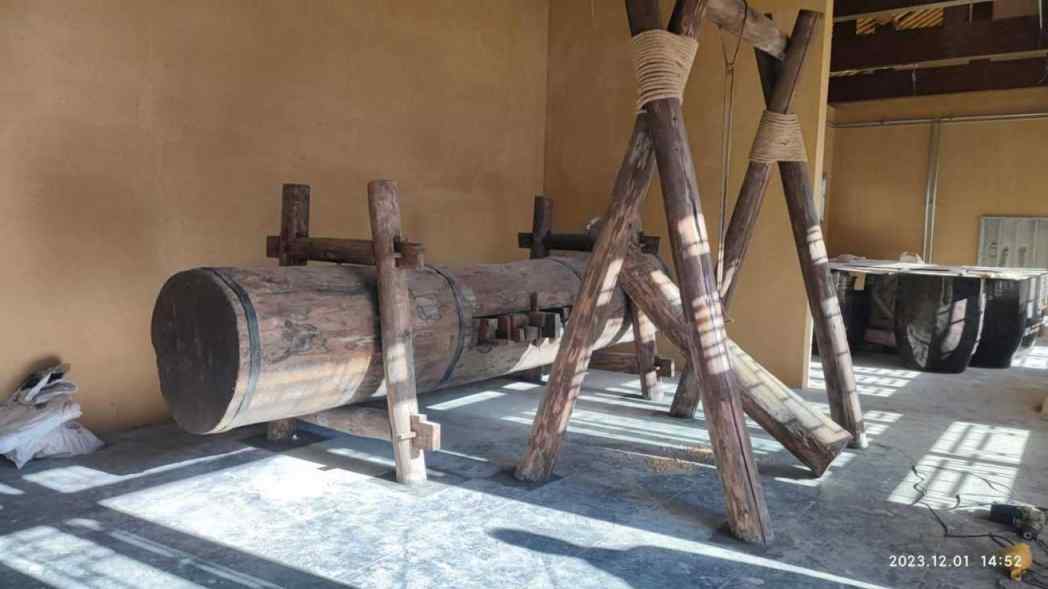
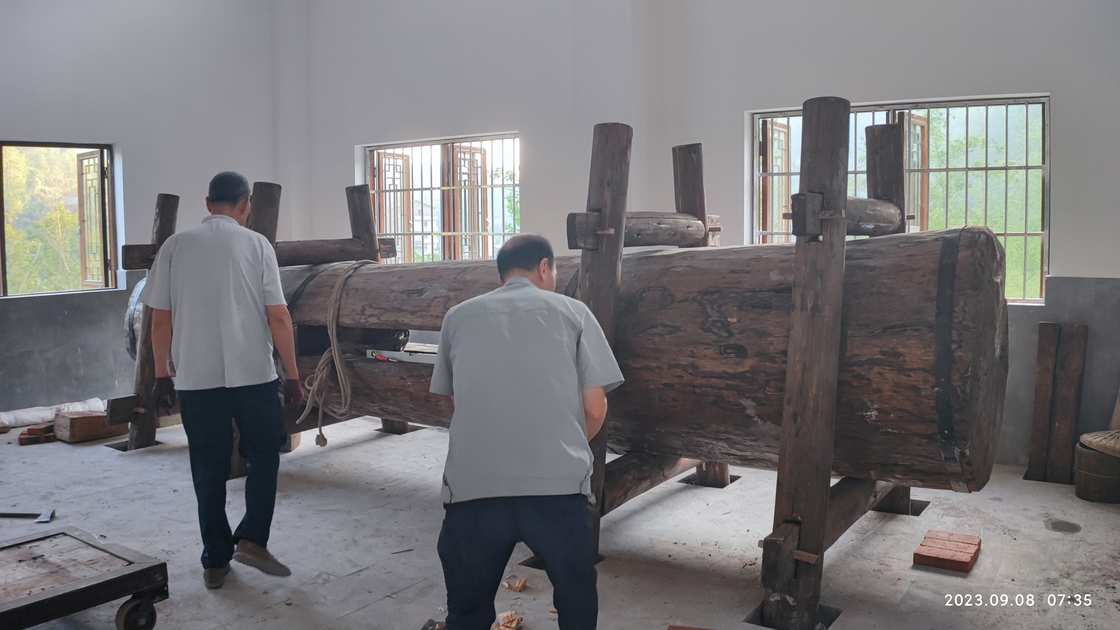
A traditional Chinese wooden oil press (mulong zha, ) is an ancient mechanical device that uses wedges and levers to extract oil from oilseeds such as rapeseed, peanuts, sesame, and tea seeds. Handcrafted from solid wood with mortise and tenon joinery, these presses can generate tons of pressure without any metal fasteners or hydraulic components. At Zhongyu Woodcraft, we build authentic working replicas based on historical designs documented in Chinese agricultural texts, serving museums, cultural tourism projects, and organic farms worldwide.
The Chinese wooden oil press, known as mulong zha (, “wooden dragon press”) or xie shi zha (, “wedge press”), has been used in China for over 1,500 years. The earliest written records appear in the Qimin Yaoshu (Essential Techniques for the Welfare of the People), compiled by Jia Sixie in 533-544 AD during the Northern Wei Dynasty.
By the Song Dynasty (960-1279 AD), wooden oil presses were widespread across China’s agricultural regions, and by the Ming Dynasty (1368-1644 AD), the technology had been refined to its peak. Song Yingxing’s Tiangong Kaiwu (1637) provides detailed illustrations and descriptions of the oil pressing process, including the construction of the wooden press, the preparation of oilseed cakes, and the wedge-driving technique.
The basic principle is simple but powerful: oilseeds are roasted, ground, and steamed, then wrapped in straw or cloth to form round cakes. These cakes are stacked inside a heavy wooden trough, and wooden wedges are driven between the cakes and a fixed beam using a heavy mallet. As the wedges are driven deeper, the pressure increases steadily, forcing oil out of the seed cakes and into a collection channel below.
| Feature | Specification | Benefit |
|---|---|---|
| Press Type | Traditional wedge and lever (mulong zha) | Authentic historical design, no metal fasteners |
| Main Beam Material | Solid camphor wood or Chinese fir (single log) | Natural strength, aromatic oil resistance, durability |
| Overall Dimensions | Length 3-6m, Width 0.8-1.2m, Height 1.2-1.8m | Custom sizes for different spaces and capacities |
| Weight | 500-2,000 kg (depending on size) | Massive construction generates high pressure |
| Maximum Pressure | 50-100 tons (estimated at wedge contact) | High extraction efficiency, comparable to modern presses |
| Oilseed Capacity | 5-50 kg per batch (customizable) | Suitable for demonstration or small-scale production |
| Oil Yield | 30-40% (rapeseed), 40-50% (peanut), 45-55% (sesame) | Comparable yield to modern mechanical presses |
| Craftsmanship | Traditional mortise and tenon joinery, no nails | Authentic appearance, structural flexibility, repairable |
| Finish | Natural wood oil, food-safe tung oil, or custom paint | Food-safe for actual oil production, beautiful appearance |
| Working Status | Fully functional (can actually press oil) or decorative | Choose working replica for museums, decorative for display |
Every oil press we build is constructed from a single solid log for the main beam, ensuring maximum structural integrity and pressure-bearing capacity. The beam is hand-shaped using traditional adze and plane tools, then seasoned for at least six months before assembly to prevent warping or cracking under pressure.
| Component | Recommended Wood | Alternative | Function |
|---|---|---|---|
| Main Beam (Longmen) | Camphor wood (single log) | Chinese fir, elm | Provides fixed resistance point for wedge pressure |
| Press Trough (Cao) | Camphor wood or teak | Chinese fir | Holds oilseed cakes, channels oil to collection point |
| Wedges (Xiezi) | Hardwood (oak, beech, or zelkova) | Pressure-treated pine | Driven between cakes and beam to generate pressure |
| Mallet (Chuizi) | Hardwood with lead or iron core | Solid hardwood | Used to drive wedges, typically 10-20 kg |
| Support Frame (Jiazi) | Chinese fir or pine | Any structural wood | Elevates press to working height, provides stability |
| Oil Collection Tray | Camphor wood (food-safe) | Stainless steel (modern upgrade) | Collects pressed oil, channels to storage container |
Camphor wood is the traditional choice for oil press construction because its natural aromatic oils repel insects and resist fungal growth, even in the oily, moist environment of an oil press. The wood’s tight grain also prevents oil from seeping deep into the beam, making cleaning easier and preventing rancid oil buildup over time.
All food-contact surfaces are finished with pure tung oil (yóu tóng yóu), a traditional Chinese wood finish that is food-safe when fully cured. Tung oil polymerizes to form a hard, waterproof, and heat-resistant surface that does not react with oil or food acids. We never use modern polyurethane or epoxy finishes on food-contact surfaces, as these can leach chemicals into the oil.
The oil pressing process using a traditional wooden press involves several carefully timed steps, each requiring skill and experience:
| Step | Process | Duration | Key Detail |
|---|---|---|---|
| 1. Roasting | Oilseeds roasted in iron wok over wood fire | 15-30 minutes | Constant stirring prevents burning, enhances flavor |
| 2. Grinding | Roasted seeds ground in stone mill or mechanical grinder | 20-40 minutes | Fine, uniform grind maximizes oil extraction |
| 3. Steaming | Ground meal steamed in wooden steamer over boiling water | 10-15 minutes | Heat and moisture soften oil cells, improve flow |
| 4. Cake Forming | Hot meal wrapped in straw or cloth, pressed into round cakes | 5-10 minutes | Cakes must be uniform thickness for even pressure |
| 5. Stacking | Cakes stacked in press trough between wooden separators | 5-10 minutes | Typically 10-20 cakes per batch, depending on press size |
| 6. Wedge Driving | Wedges driven between cake stack and beam with heavy mallet | 20-40 minutes | Wedges added gradually, pressure increases steadily |
| 7. Pressing | Pressure maintained, oil flows out continuously | 1-2 hours | Wedges re-tightened periodically as cakes compress |
| 8. Cake Removal | Wedges removed, compressed oilseed cakes extracted | 10-15 minutes | Spent cakes used as animal feed or fertilizer |
| 9. Oil Settling | Fresh oil settled in tanks to separate sediment | 3-7 days | Gravity settling produces clear, pure oil without filtering |
The entire process from raw seeds to finished oil takes approximately 4-6 hours for a skilled operator, though the pressing and settling stages require patience. Traditional oil pressing is as much an art as a craft: the operator must judge the correct roasting temperature, grind consistency, steaming time, and wedge pressure by sight, smell, and touch, much like a master chef or brewmaster.
Oil produced by traditional wooden pressing is prized for its rich, complex flavor and aroma, which many chefs and food enthusiasts prefer over oil from modern screw presses. The slow, cold-pressing process (the friction generates some heat, but much less than modern screw presses) preserves more of the oil’s natural antioxidants, vitamins, and flavor compounds.
| Application | Recommended Size | Working or Decorative | Key Feature |
|---|---|---|---|
| Museum Exhibit | Full-size (4-6m) or scale model | Working (for demonstrations) | Historical accuracy, educational signage |
| Cultural Tourism Park | Full-size working press | Working (visitor participation) | Interactive demonstration, photo opportunities |
| Ancient Town / Heritage Street | Full-size working press | Working (small production) | Authentic atmosphere, fresh oil for sale |
| Organic Farm / Eco-Resort | Medium-size (3-4m) | Working (farm production) | On-site oil production for farm-to-table dining |
| Restaurant / Cooking School | Small-medium (2.5-3.5m) | Working (demonstration) | Freshly pressed oil for signature dishes |
| Private Collector | Custom size or scale model | Decorative or working | Museum-quality craftsmanship, provenance documentation |
| Film / TV Production | Full-size prop | Decorative (lightweight) | Authentic appearance, safe for actors, easy to move |
For cultural tourism projects, a working oil press becomes an interactive attraction where visitors can try their hand at driving the wedges (under supervision, of course) and take home freshly pressed oil as a souvenir. One of our clients at a cultural park in eastern China reported that their oil press demonstration became the park’s second most popular attraction, with visitors spending an average of 25 minutes watching and participating.
For organic farms and eco-resorts, a traditional oil press allows you to produce your own cold-pressed oil from locally grown oilseeds, creating a unique farm-to-table experience for your guests. The press itself becomes a focal point of your farm tour, telling the story of traditional agricultural craftsmanship.
| Factor | Zhongyu Woodcraft | Typical Carpenter | Mass Producer |
|---|---|---|---|
| Historical Research | Study ancient texts, museum artifacts, existing presses | Guess based on photos | Standardized design, no historical basis |
| Master Craftsmen | 30+ with 20+ years, some from oil-pressing families | 1-2 general carpenters | Factory workers, no traditional training |
| Wood Selection | Single-log beams, 6-month seasoning, hand-selected | Whatever is available | Cheapest available, often green wood |
| Joinery | Traditional mortise and tenon, hand-cut, no nails | Mixed joinery, may use screws | Nails, screws, glue, no traditional joinery |
| Food Safety | Food-safe tung oil finish, no toxic chemicals | Unknown finish, may be toxic | Polyurethane or paint, not food-safe |
| Working Status | Fully tested, actually presses oil before shipping | May or may not work | Decorative only, cannot generate pressure |
| Customization | Full custom design, size, wood type, decoration | Limited customization | Standard sizes only |
| Documentation | Historical research notes, construction photos, care guide | Basic instructions | Assembly instructions only |
Before shipping, every working oil press is fully assembled and tested in our workshop. We actually press a batch of oilseeds to verify that the press generates sufficient pressure, that all joints hold under load, and that oil flows correctly through the collection channel. Only after passing this test do we disassemble the press for shipping, with each component numbered and labeled for easy reassembly at your location.
We provide detailed assembly instructions, a historical research booklet documenting the design’s provenance, and a comprehensive care and maintenance guide. For an additional fee, our master craftsman can travel to your location to assemble the press and provide hands-on training in traditional oil pressing techniques.
Q: Can a traditional wooden oil press actually produce oil, or is it just decorative?
A: Our presses are fully functional and can actually produce oil. Before shipping, we test every press by pressing a batch of oilseeds in our workshop. A properly built wooden press can generate 50-100 tons of pressure at the wedge contact point, which is sufficient to extract oil from most oilseeds with yields comparable to modern mechanical presses. We also offer decorative-only versions for clients who only need the visual appearance.
Q: How much oil can a traditional press produce per day?
A: Production capacity depends on press size and operator skill. A medium-size press (3-4m beam) with an experienced operator can process 50-100 kg of oilseeds per day, producing 15-40 liters of oil depending on the oilseed type. Larger presses (5-6m beam) can process 200-500 kg per day. For comparison, modern screw presses can process several tons per day, but the traditional process produces oil with superior flavor and nutritional value.
Q: What types of oilseeds can be pressed in a traditional wooden press?
A: Traditional wooden presses can process virtually any oilseed, including rapeseed (canola), peanuts (groundnuts), sesame, sunflower seeds, tea seeds (camellia), walnuts, almonds, flaxseed, perilla seeds, and cottonseed. The optimal pressing temperature and moisture content vary by oilseed type, and our care guide includes recommended parameters for the most common oilseeds. Some oilseeds with very high oil content (such as sesame) may require additional cake separators to prevent the cakes from slipping under pressure.
Q: How long does a wooden oil press last, and what maintenance does it require?
A: A well-built wooden oil press can last 50-100 years or more with proper maintenance. The main beam and trough, made from solid camphor wood, are extremely durable and rarely need replacement. Consumable parts include wedges (which may split after years of use), straw or cloth wrappers (replaced each batch), and the mallet head (may need re-facing). Maintenance involves cleaning the press after each use to remove oil residue, applying food-safe tung oil to wood surfaces annually, and inspecting wedges and joints for wear. We provide a comprehensive maintenance schedule and can supply replacement parts for any press we build.
Q: Is oil from a traditional wooden press safe to eat?
A: Yes, oil from a properly built and maintained traditional wooden press is perfectly safe to eat. In fact, traditional cold-pressed oil is often considered superior to industrially refined oil because it retains more natural antioxidants, vitamins, and flavor compounds. The key safety factors are: using food-safe wood finishes (we use pure tung oil on all food-contact surfaces), cleaning the press thoroughly after each use to prevent rancid oil buildup, and allowing freshly pressed oil to settle for 3-7 days to separate sediment. We provide detailed food safety guidelines with every press we sell.
Q: How much does a traditional wooden oil press cost?
A: Prices range from $2,000 for a small decorative model to $15,000+ for a full-size working press with premium camphor wood beam and custom carvings. The final cost depends on size, wood type, working vs. decorative status, and decorative features. Contact us with your specifications for a detailed quotation within 48 hours. We also offer scale models (1:2, 1:4, 1:10) for museums and collectors at lower price points.
Q: Can you ship a wooden oil press internationally, and how is it packaged?
A: Yes, we ship worldwide. Each press is disassembled into numbered components, wrapped in protective foam, and packed in ISPM-15 certified heat-treated wooden crates. The main beam, being the largest and heaviest component, is crated separately with additional bracing. We handle all export documentation including commercial invoice, packing list, certificate of origin, and phytosanitary certificate. Assembly at your location typically takes 2-4 people and 1-2 days, following our detailed numbered instructions. We also offer on-site assembly and training services worldwide.
Q: Do you provide training in traditional oil pressing techniques?
A: Yes, we offer comprehensive training for clients who purchase working presses. Our standard package includes a detailed video training series covering the entire oil pressing process from seed selection to finished oil. For an additional fee, our master craftsman can travel to your location to provide 2-5 days of hands-on training, including roasting, grinding, steaming, cake forming, wedge driving, and press maintenance. We can also connect you with experienced traditional oil press operators in your region for ongoing consultation.
Ready to add an authentic traditional Chinese wooden oil press to your museum, cultural park, farm, or collection? Contact us today for a free consultation and detailed quotation. Our team typically responds within 24 hours with expert recommendations based on your space, budget, and intended use.
To learn more about the history and craftsmanship behind traditional Chinese oil pressing, read our complete guide to traditional Chinese woodworking techniques, which covers mortise and tenon joinery, wood selection, and the historical context of Chinese craft traditions.
Call/WhatsApp: +86 13883366528
Zhongyu Woodcraft – 48 Years Traditional Chinese Woodcraft Factory, Nationwide Installation
| Origin | Chongqing, China |
|---|---|
| Brand | Zhongyu Wood Art |
| Material | Solid wood (pine/fir/cedar/teak available) |
| Craftsmanship | Traditional mortise-and-tenon joinery |
| Surface Finish | Weather-resistant outdoor coating |
| Dimensions | Customizable based on site requirements |
| Installation | On-site installation available worldwide |
| Lead Time | 15-30 days depending on complexity |
| MOQ | 1 set |
| Packaging | Standard export packaging |
| Lifespan | 30-50 years with proper maintenance |
| Warranty | 2-year structural warranty |
Call / WhatsApp same number · Reply within 24 hours
☎ Hotline: +86 13883366528 (WhatsApp same number) · 💬 WhatsApp
几代老师傅 · 在线咨询
We will contact you within 24 hours.