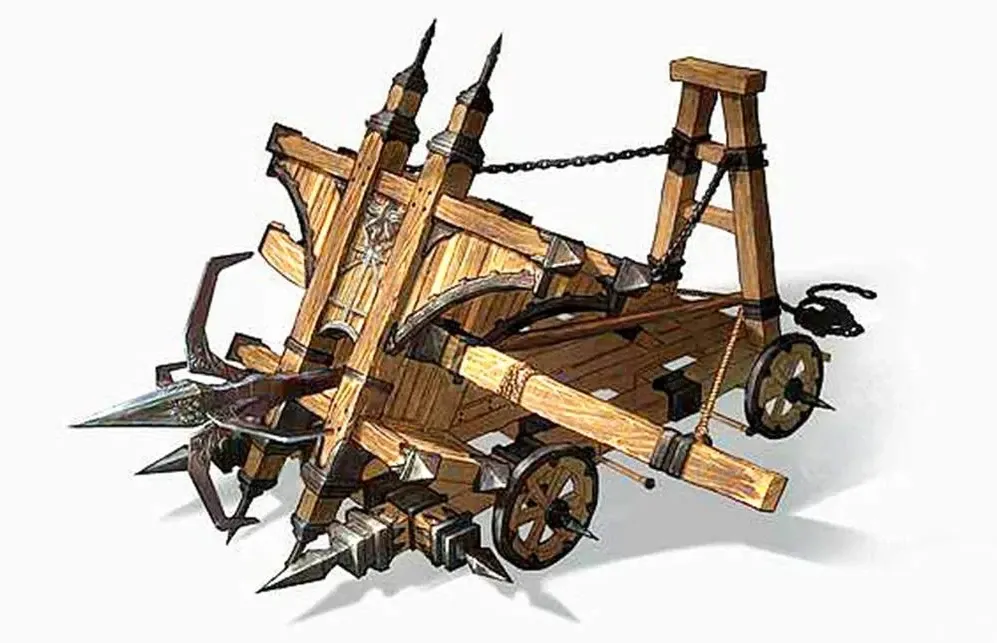
A replica siege engine on a theme-park stage is asked to do something the original never did: repeat. Eight swings a night, six nights a week, for a season of twenty weeks is 960 loaded cycles on an arm that was designed, in the eleventh century, to be used once against a wall. The engineering question is not whether the replica looks right. It is whether the pivot, the brake and the counterweight still agree with each other on the nine-hundredth swing.
We build these props from a fixed set of numbers: an arm of 6.0-7.5 m, a counterweight box of 300-450 kg, a swing arc timed to 4.5-5.5 seconds, and a hard stop set 200 mm short of the stage line. Change one of those and the others have to be recalculated.
What the Song manual actually specified
Wujing Zongyao (Essentials of the Military Classics, 1044), in its section on siege equipment, describes four families of machine: the yunti or scaling ladder, the paoche or traction trebuchet, the zhuangche or battering ram, and the chaoche or tower wagon. What the text gives is not a set of drawings but a set of relationships: the counterweight scales with the arm, the arm scales with the number of operators, and the frame is braced against the direction of the throw rather than around it.
That hierarchy is exactly what a stage prop needs, because a theme park changes the operators and keeps the throw. A traction trebuchet that needed forty pullers on a battlefield can be driven on stage by eight performers and one hidden counterweight, provided the frame is braced for the direction of the swing and the arm is re-rated for the new load path.
The load path of a swinging arm
Most failures we are asked to repair are not failures of timber. They are failures of the pivot, where a softwood axle has been fitted into a hardwood frame and has worn a slot 12-18 mm wide over a season.
Pivot and bearing
Use a replaceable bearing block, not a hole drilled straight through the frame. A block of dense hardwood, 80-100 mm thick, bolted to the frame and keyed against rotation, can be swapped in twenty minutes during a changeover. The axle itself should be a separate piece, 90-120 mm diameter, with a sacrificial sleeve at the bearing faces.
Counterweight and brake
The counterweight box must be closed and locked, with the mass declared on a plate. A 300 kg box that can shift 50 mm during a swing will change the timing of the arc by nearly a second, which is enough to put a performer in the wrong place. The brake should act on the axle, not on the arm: a friction band on a drum is predictable, a rope on a moving beam is not.
| Prop type | Moving parts | Stage crew | Cycle time | Inspection interval |
|---|---|---|---|---|
| Scaling ladder (yunti) | Hinged base, rope stays | 4 | 20-30 s | Every 40 cycles |
| Traction trebuchet (paoche) | Arm, axle, counterweight, brake | 8 + 1 brake | 4.5-5.5 s | Every 20 cycles |
| Battering ram (zhuangche) | Rollers, ram, roof frame | 6 | 8-12 s | Every 30 cycles |
| Tower wagon (chaoche) | Wheels, ladder rail | 5 | Static per scene | Daily visual |
Safety envelope, written for performers
The clearance zone around a swinging arm is the number that stage managers under-specify. Work it out from the arc, then add the stopping distance: for a 7.0 m arm with a 5.0 s cycle, the tip travels about 11 m in the downswing, and a hard stop 200 mm short of the stage line means the last 400 mm of travel happens in roughly 0.1 s.
Three rules keep that envelope honest. Mark the floor, not the air: tape lines are read by performers under stage light, sight lines are not. Give the brake operator a separate cue from the arm crew. And never let a performer stand inside the arc to “catch” the arm on a rehearsal, because that is the one move the brake cannot protect.
Changeover, transport and storage
A prop that takes four hours to strike will not survive a repertory schedule. Design for a two-hour changeover with four people:
– The arm detaches at the bearing block with two bolts, not eight.
– The counterweight box splits into 50 kg units that one person can carry.
– The frame breaks into panels no longer than 2.4 m, so it fits a standard truck bed and a backstage door.
– Every part carries a painted number that matches the assembly sheet, because the crew on a Tuesday is rarely the crew that built it.
Storage is where moisture gets in. A prop stored outdoors between seasons will move 6-10 mm at its joints after one wet winter. Store under cover, on battens, with the arm supported at both ends rather than cantilevered from the pivot.
Maintenance schedule for a working prop
– Before every show: visual check of the axle sleeve, the brake band and the hard stop.
– Every 20 cycles: measure bearing wear at the block, record in the show log.
– Every 100 cycles: re-torque frame bolts, inspect the counterweight lock.
– Every season: replace the sleeve, re-coat exposed end grain, and re-check the swing timing with a stopwatch against the cue sheet.
The stopwatch test is the cheapest diagnostic available. If the arc is 0.3 s slower than at opening, something in the pivot has changed, and it will keep changing until it is replaced.
Questions from production teams
Can the prop be built lighter for touring? Yes, but the counterweight must be re-rated, not simply reduced. A lighter arm with the same box swings faster and hits the stop harder.
Do we need engineering certification? For any prop with a moving arm above head height and performers in the space, yes. Supply the load calculation, the brake rating and the inspection log together.
How accurate should the replica be? Accurate enough to read from row ten, honest at the joints. Audiences see silhouette and proportion; they do not count brackets. Spend the budget on the pivot instead.
What is the usual lead time? Ten to fourteen weeks for a trebuchet-class prop with a tested brake, including one full assembly and cycle test before crating.
If you are specifying a siege engine for a show and the safety envelope is still open, send the stage plan and the cue timing. We will return a pivot and brake proposal that matches your cycle count.
Talk to us: +86 138 8336 6528
Related reading: siege engines as stage props: a replica catapult that swings safely eight times a night
Product reference: how to choose a historical chariot replica