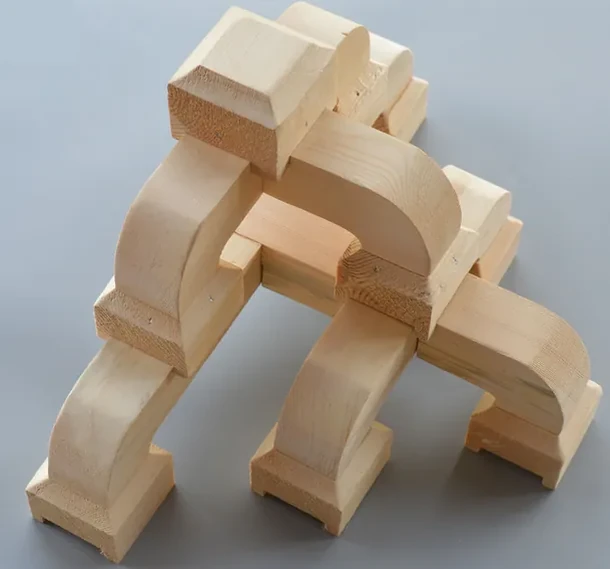
A bracket set is the part of a Chinese timber building that visitors photograph and conservators argue about, and it is also the part most likely to be rebuilt by someone who has only seen photographs of one. Dougong bracket sets are not ornament bolted to a wall. They are a load path: each arm transfers roof load outward and downward, and every block between the arms keeps that path from sliding sideways.
The Yingzao Fashi (Building Standards, Li Jie, 1103) fixes the logic in its chapter on major carpentry, where the module system caifen grades timber into eight classes. A first-class module is 15 fen wide, 10 fen deep, with a 6 fen gap called qie between stacked members, giving 21 fen for a full-height zucai. Every bracket arm, block and beam in the building is a multiple or fraction of that unit. That is why a bracket set can be scaled up or down without losing its proportions, and why a set rebuilt to photographs alone looks wrong from three metres away.
The names, because half the confusion is vocabulary
Dougong is written several ways in Chinese sources and translated several ways in English ones, and the parts have their own labels. Anyone specifying a repair or an exhibit will meet all of them.
Dougong / dougong / dou-kung. The whole bracket set: the cluster of blocks and arms that sits on a column head or between columns.
Ludou. The large cap block at the base of the set, carrying the first tier of arms.
Huagong. The arm that projects outward from the wall plane, the one that produces the overhang.
Nidaogong and linggong. Arms that run parallel to the wall, one inboard, one at the outer end of the projection.
Ang. The down-sloping member, sometimes cut as a beak, that adds reach and carries the eave purlin.
Shuatou. The final projecting member at the top of the set, usually decorative but structurally pinned.
Queti. The bracket-like corbel at the junction of column and beam, also called jiaoti in older texts. It is not a bracket set, but it is often supplied with one.
Gualuo. The carved hanging lattice under a beam or eave, an ornament with almost no structural role, which is exactly why it should be the lightest part of the assembly.
Three ways to deliver a bracket set, and when each one is right
The choice is not aesthetic. It follows from what the client will do with the object: leave it outdoors for thirty years, put it behind glass, or truck it between venues twice a year.
| Approach | Construction | Weight per set | Outdoor life | Reversible | Suits |
|---|---|---|---|---|---|
| Solid timber replica | Larch, oak or camphor, mortise and tenon, no adhesive in the load path | 30-45 kg for a 3-tier set | Long, with an oil finish and annual inspection | Partly | Restored halls, new pavilions, open-air heritage parks |
| Laminated core with timber facing | Glued laminated spruce core, solid timber arms and blocks as facing, stainless pins | 25-35 kg | Medium; needs a drained and ventilated detail | No | Large spans, high wind load, budget-driven projects |
| Exhibit kit | Timber arms on a demountable steel spine, numbered parts, no glue | 18-28 kg, splits into 3-4 pieces | Indoor only | Yes, in under an hour | Museum display, touring exhibitions, interpretation walls |
The exhibit kit is the one most museums actually need. A bracket set shown at eye level teaches more if a visitor can see the tenon, and a set that comes apart into numbered pieces can be reinstalled by two technicians with a drawing, which is what touring schedules demand.
Repairing an existing set without erasing it
Most damaged sets fail in three predictable places, and none of them call for replacing the whole cluster.
Crushed tenon shoulders. Load over decades compresses the shoulder of the tenon where it bears on the block. A crushed shoulder can be built up with a matched timber patch let in as a dovetailed insert, oriented so the new grain runs the same way as the old. It is visible under close inspection, which is correct: a repair should be legible, not invisible.
Splitting along the arm. Arms split where a hidden pin or an old iron nail was driven in. Pull the metal, dry the timber to the local equilibrium moisture content, and close the split with a spline rather than filling it with putty.
Biological decay at the block faces. Blocks sit in the rain shadow of the eave and stay wet longest. Where decay is superficial, surface consolidation is enough. Where it reaches the load path, the block is replaced in the same species and the same module class, and the replacement is dated in the record.
Two rules keep repairs honest. No adhesive in a joint that was designed to be dry-jointed, and no member replaced in a different species without recording it. A conservation officer will ask both questions.
Installation, and the annual routine
Bracket sets are installed after the column line is plumb and before the roof load is applied. Each set is bedded on a levelled column head, checked for square to the wall plane, and pinned only after the full tier is in place, because a set pinned early cannot be adjusted when its neighbour goes in.
The annual inspection is short: look for gaps opening at the block faces, check the pins for movement, clear debris from the rain shadow pockets, and re-oil the surfaces that face the weather. Anything that has moved more than a few millimetres in a year is telling you the load path has changed, and that is the moment to look at the roof above it.
Frequently asked questions
Can a bracket set be made without glue and still pass a structural check? For a display set or a small pavilion, yes; the traditional joint is a bearing joint and the pins are locating pins, not fasteners. For a large span with high wind load, an engineer will usually ask for a laminated core or a steel spine, and that is a different product.
How close can a replica get to the original? Visually, very close, if the module class is respected. Structurally it is a new object with new timber, and it should be labelled as one.
Do you work from photographs or from a survey? A measured survey is better, but photographs plus two known dimensions, such as the column diameter and the bay spacing, are usually enough to reconstruct the module and from that the whole set.
How long does a set take? Four to six weeks for a three-tier set including drawings, longer if the client needs a conservation report with the object.
Can it ship with a pavilion? Yes, and it should: sets are crated as numbered parts and installed by the same crew that assembles the frame, which avoids the usual problem of brackets fitted to a frame that was erected slightly out of square.
For the timber capability behind these sets, including full-size replication to reference drawings, see our custom timber replication work. For the frame that carries them, read this guide to how an ancient pavilion is built. We do not yet have a dedicated bracket-set page on the English site, so send the photographs, the two known dimensions, and whether the set is for outdoor or exhibit use, and you will get a module-based proposal with a crating plan.
Zhongyu Wood Craft, Chongqing, China. Heritage timber work since 1978. Telephone and WhatsApp: +86 138 8336 6528.